

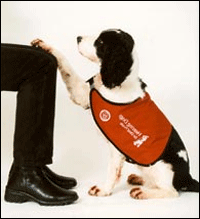
- Hearing dogs alleviate the stress, isolation and depression that deafness can often bring
- But greater awareness of hearing dogs is still needed with 78% of deaf recipients saying they have been denied access to public services on the grounds that they have an assistance dog
- Charity hopes more employers will make ‘reasonable adjustments’ to encourage more hearing dog recipients into the workplace
Ahead of National Stress Awareness Day (November 7), charity Hearing Dogs for Deaf People has released statistics which it hopes shows how deafness remains a misunderstood disability and in turn, educate the public further about the access rights of hearing dog recipients.
In a recent survey conducted by the Charity*, 78% of hearing dog recipients said that they had at least on one occasion been turned away by a service provider simply because they were accompanied by their hearing dog. In addition over half of those surveyed (52%) were left angered by an access refusal, with 45% saying they felt discriminated against while 31% were left feeling embarrassed.
The Charity – who currently has around 750 hearing dogs across the UK – adds that 30% of those refused access said that they were left feeling humiliated because of the experience, while almost one-fifth (20%) said such an event made them feel tearful.

In addition, the survey asked recipients how their hearing loss – prior to getting a hearing dog – made them feel.
Recipients said that prior to having a hearing dog, their deafness made them feel lonely (82%), isolated (78%), stressed (71%), vulnerable (67%), depressed (59%) and even in some cases, suicidal (14%). However, the introduction of a hearing dog made them feel more secure (92%), feel less stressed (90%), feel more approachable (89%), more able to cope (85%), and more included (74%).
On National Stress Awareness Day, the Charity is calling on service providers to have greater awareness of the rights of hearing dog owners and how an unlawful access denial can have a troubling impact on recipients, many of whom have experienced high levels of stress prior to getting a hearing dog.
Philip Biggs, access and inclusion manager at Hearing Dogs for Deaf People, said: “Equality for deaf people with a hearing dog is a human right and we must recognise that. If recipients are refused access whilst they are accompanied by a hearing dog, it can be a traumatic and often isolating situation.
As a charity, we hope that by raising awareness of the work of a hearing dog, we will subsequently help to educate service provider. Hearing dogs undergo extensive training in order to qualify as a recognised assistance dog. The Chartered Institute of Environmental Heath has endorsed the rigorous training that we provide and confirms that they do not pose a risk to health, so there is very little excuse.”
According to the survey, restaurants and cafes along with taxi firms cause recipients the most difficulty.
Of those refused access, almost a quarter (23%) said that they had been denied access to a restaurant or cafe, while 22% said that they had been turned away from taxis. Other providers with poor feedback from recipients included local stores (17% reported difficulty) and 11% had the same problem with B&Bs.
Hearing Dogs for Deaf People hopes to encourage service providers to display ‘assistance dogs only’ stickers – backed by umbrella organisation Assistance Dogs – which alerts assistance dog owners that they are welcome to enter that particular premises.
In addition, the Charity hopes to persuade more employers to take on hearing dog recipients in their work place. Given reasonable adjustment, the Charity says that a hearing dog can help a recipient hugely in the work place, removing levels of hearing loss-associated stress which can often be a problem for a deaf person in environments such as the work place where lots of people communicate at the same time.
Of those hearing dog recipients currently in work, three-quarters (75%) said that their employer was happy for them to bring their hearing dog to work, but the Charity hopes to see this figure increase further.
Since 1982, Hearing Dogs for Deaf People has created over 1,600 partnerships. It is a non-government funded organisation and relies on the support of the public.




