There’s a fascinating TV programme on the National Geographic Channel I enjoy called Air Crash Investigation.
To be honest, if you’re a frequent flyer like me, it’s maybe not that good an idea to watch it. After all, it takes an in-depth look at some of the worst ever passenger aircraft disasters. Not always reassuring!
If however you’re interested in safety, it comes highly recommended. In particular, the show highlights the importance of accident investigation. It shows that by thorough examination of incidents, mistakes can be avoided in the future.

Over the past 20 years, the accident rate for Western-built jet airlines has improved considerably. Figures from the Flight Safety Foundation (FSF) show that in the early 1990s there were 1.32 serious accidents per million flight departures involving such aircraft. By the end of the 1990s this had fallen to 1.06 per million departures. Things are even better now at around 0.5 per million.
There can be no doubt that a major part of this improvement has come about through the determined approach taken by the airline industry and authorities towards investigating accidents and putting controls in place to ensure similar events do not happen again.
I believe it’s vital that all industries and places of work investigate accidents, whatever their cause. As employers we must all learn from mistakes that lead to accidents and control them. However, it’s also important to mention that the TV show Air Crash Investigation only reveals half of what accident investigators do.
Take the Air Accidents Investigation Branch (AAIB) in Britain for example. It carries out investigations defined under one of two categories – an “accident” or “serious incident”.
An “accident” is when someone suffers a fatal or serious injury, an aircraft sustains damage or structural failure, or where an aircraft goes missing. A “serious incident” refers to a situation where an accident nearly occurred.
The TV show Air Crash Investigation rarely looks at what are commonly known as “near misses”. After all, such events are usually less dramatic. But as employers, we must never forget them.
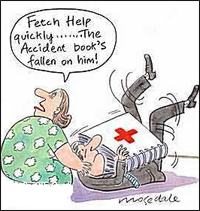
Accident investigation isn’t just about investigating accidents. It’s also about investigating things that nearly happened. Make sure you have a system in place to identify near misses, look into them thoroughly and then put controls in place. After all, next time you may not get away with it.
About Teresa Budworth

Teresa Budworth, Chief Executive of the National Examination Board in Occupational Safety and Health
During a 30 year career in health and safety, she has specialised in safety consultancy; working with a number of Boards of Directors on implementing safety governance within large and diverse organisations. Her work on competence, education and training culminated in her appointment as Chief Executive of NEBOSH; the National Examination Board in Occupational Safety and Health, in 2006.
Prior to joining NEBOSH, Teresa combined management of Norwich Union Risk Service’s (now Aviva) Consultancy operation with her post as a non-executive Director and Trustee of NEBOSH and was Senior Examiner for Diploma Part One from its inception in 1997. She is a Visiting Senior Teaching Fellow and member of the Examination Board for post graduate courses in Occupational Health at the University of Warwick’s Medical School. She is a member of RoSPA’s National Occupational Safety and Health Committee and also serves on the judging panel for RoSPA’s annual occupational safety and health awards. She is a member of IOSH Council.
- Teresa Budworth

- Teresa Budworth
- Teresa Budworth
- Teresa Budworth