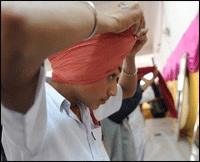
 Religious dress at work is a subject that is never far from the news and one that continues to cause confusion for employers. Previous high profile cases have included decisions stating that it was acceptable to ask a reading assistant to remove her hijab and to prevent an airline worker from wearing a visible cross.
However, a recent tribunal decision has stated that a London luggage retailer was wrong to pressure a Muslim worker to remover her headscarf whilst at work.
So where does this new case leave employers and how far can they go in trying to enforce a uniform or dress-code at work?
Farrah v Global Luggage Co Ltd
Background

This tribunal decision from August relates to a claim brought by Muslim worker, Ms Farah, against her former employer Global Luggage.
Ms Farah worked part-time for the company, run by three siblings and overseen by their father, attending the Oxford Street store on Saturdays and the Piccadilly store on Sundays. Although a practising Muslim, Ms Farah does not always wear religious dress. She had not done so at her interview, but did at times attend work wearing a headscarf. On one of these occasions, in October 2011, she was seen by Christopher Ford, one of the three sibling owners.
The following day the siblings’ father, Terry Ford, phoned the store to speak with his son Christopher. Ms Farah overheard the conversation, which enquired as to whether or not she intended to continue wearing her headscarf to work. Later that same day, Elizabeth Ford, another of the siblings, phoned to request that Ms Farah move with immediate effect to the Oxford Street store. When Ms Farah asked if her headscarf was behind this request, she was told that the company were “trying to be trendy” at the Piccadilly branch. After this, Ms Farah was permanently placed at the Oxford Street store, which was accepted to be
less nice and her duties were diminished to include cleaning shelves.
Following an incident where Ms Farah and a colleague took a two-hour lunchbreak, instead of the allotted one hour, a letter was sent to all staff saying that the company needed to make staff cuts and that it would be doing these based on work ethic. It was accepted by the tribunal that at this point, the company had decided that it wished to get rid of Ms Farah due to her continued headscarf wearing.
A meeting was had with Ms Farah where it was put to her that she could resign with a good reference, or be dismissed without one. Ms Farah chose to resign. Despite the stated need for cuts, the company went on to expand its workforce.
Tribunal decision
Following this, Ms Farah brought a claim for unfair dismissal and direct discrimination. The tribunal concluded that she had in fact been dismissed or constructively dismissed as a result of being put in a position where she had no option but to resign. However, the tribunal stated that Ms Farah was wrong to bring a direct discrimination claim, rather than an indirect discrimination claim.
Legal Issues – direct or indirect discrimination
The concepts of direct and indirect discrimination cause confusion to many employers, yet they are key in assessing what may or may not constitute discrimination.
Direct discrimination
Ms Farah claimed direct discrimination on the basis of religion over the company’s treatment of her headscarf wearing.
For a tribunal to assess direct discrimination, there needs to be a ‘comparator’ who is a worker whose circumstances are ‘not materially different’. In the case of a religious person wanting to wear an item of clothing or jewellery, the comparator would be a non religious person who also wanted to wear that same item.
In Ms Farah’s case, the tribunal considered it likely that the company would have tried to prevent any worker from wearing a headscarf at work, whether they were Muslim or not.
As a result, whilst the tribunal made it clear that it had great sympathy for Ms Farah’s position, it was unable to find that she was directly discriminated against.
Indirect discrimination
Indirect discrimination on the basis of religion arises where selection criteria, rules or policies have the effect of putting workers of a particular religion or belief at a particular disadvantage. In some circumstances, employers can objectively justify such discrimination as being a proportionate means of achieving a legitimate aim.
The tribunal made it clear that had Ms Farah claimed indirect discrimination she would likely have won. This is because the policy to ban headscarves would have had a disproportionate impact on Muslims over other workers who simply chose to wear headscarves for their own reasons. The fact that Global Luggage was enforcing this policy in an attempt to be ‘trendy’ would not have been an objective justification.
These circumstances can be contrasted with the case of Azmi v Kirklees Metropolitan Council, where it was found that a school was within its rights to ask a reading assistant not to wear a full hijab. It was found that the pupils needed and benefitted from the interaction offered by being able to see Ms Azmi’s full face. Whilst the school’s request was indirect discrimination, it was justified in the circumstances.
It is important, however, that the policy places an ‘identifiable group’ at a disadvantage and not just an individual. In the well-publicised case of Eweida v British Airways Plc, Ms Eweida brought an indirect discrimination claim on the basis that she was banned from wearing a visible cross over her uniform. Her claim was unsuccessful on the basis that it did not place Christians in general at a particular disadvantage. The tribunal heard evidence that the wearing of a visible cross was a matter of individual choice for Christians and appeared to therefore draw a distinction between matters of choice and mandatory requirement.
Where to draw the line
This area of law continues to develop and in many cases it will be difficult to decide the extent to which an employer can prevent workers from wearing religious items of clothing.
As a result, the easiest and most practical option will often be to simply allow workers to manifest their religion in the way that they choose. This can bring benefits both from an HR and management perspective and also in terms of happy workers being more productive workers.
However, in many industries, particularly those that are customer-facing or involve health and safety issues, such an approach may not be as straight-forward.
In such situations, it is useful to gain an insight into the mandatory requirements of major religions and beliefs, as well as any others that may be represented in the workforce. It should be remembered that the same religion may have several different movements and what is acceptable in one may not be the same in another.
It should also be considered whether any indirect discrimination could be a justified. If the wearing of a religious item would give rise to a clear health and safety risk, or would in some other way significantly diminish the effectiveness of the worker in their role, then a ban on the wearing of the item may be justified. However, it is unlikely that an argument based solely on appearance alone would be sufficient.
Tribunals are aware that some employers chose to simply impose a blanket ban. Whilst they have admitted that this may sometimes be the only way, they have warned employers to be wary of this. As such, it would be advisable to seek full legal advice before adopting such an approach.
James Hall
Associate, Charles Russell LLP

James Hall, Associate, Charles Russell LLP
- James Hall