


Since 2010 two-thirds of the rise in employment has been in managerial, professional or associate professional occupations.
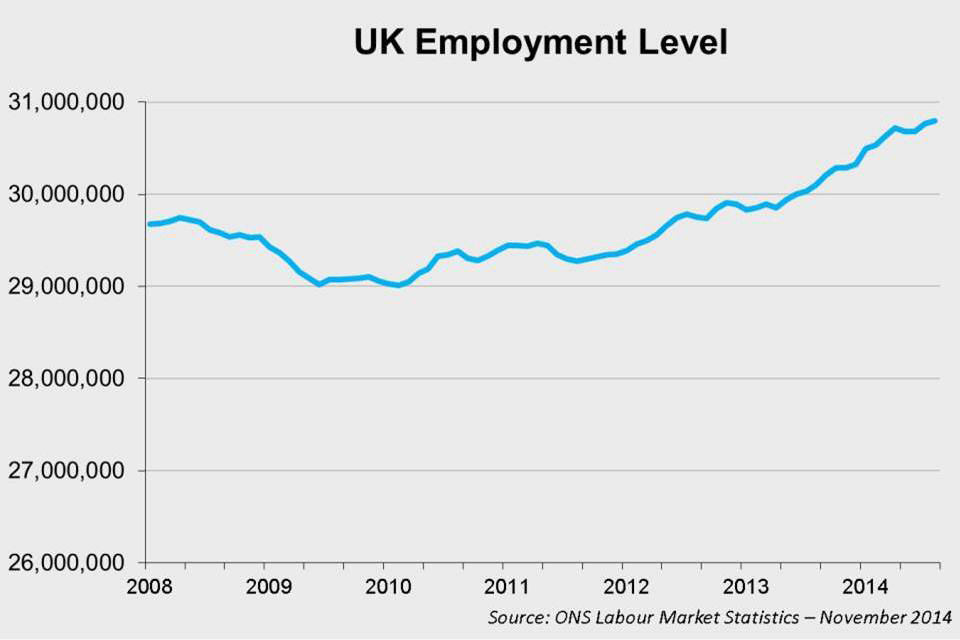
The figures from the Office for National Statistics show that 694,000 more people are in jobs compared to this time last year. Employment increased by 112,000 over the last 3 months alone, with the vast majority of the increase coming from people in full-time jobs.
There are now a record 30.8 million people in work, with the employment rate (73.0%) now back to pre-recession levels. Compared to 2010 there are over 2 million more people in private sector jobs, showing that the government’s long-term economic plan to create jobs by backing businesses is working.
 |
Get our essential weekday HR news and updates.
|


Wages are increasing – average regular pay (excluding bonuses, in the 3 months to September) rose 1.3% on the year, with private sector pay up 1.6%. This compares to an increase in the Consumer Prices Index of 1.2% in September.
Employment Minister Esther McVey said:
Record numbers of people in work means more people with the security of a regular wage who are better able to support themselves and their families.
With the vast majority of the rise in employment over the last year being full-time, it’s clear that thanks to the government’s long-term economic plan, we are helping businesses to create the jobs that people need.
More young people are getting their foot on the career ladder and we’ve seen record falls in female unemployment, so as the economy continues to grow, more and more people are having their lives transformed by moving into work.
There are over half a million fewer unemployed people than there were a year ago with schemes like the government’s Work Programme contributing to the biggest annual fall in long-term unemployment in 16 years – down by 206,000.
The number of people claiming the main unemployment benefit – Jobseeker’s Allowance – has also been falling every month for the last 2 years and is now over half a million lower than May 2010.
Young people
Youth unemployment fell by nearly a quarter of a million over the last year. The number of 18 to 24 year olds claiming Jobseeker’s Allowance has been falling for the last 35 months and is the lowest since the 1970s. Excluding full-time students, the number of unemployed young people is now 163,000 lower than in 2010.
Women
The annual fall in female unemployment is the largest on record. There are record numbers of women in work, and since 2010 three-quarters of the rise in female employment has come from managerial, professional and associate professional occupations. The UK has seen the fastest growth in the number of women in work in the last year out of all G7 economies. Of those women working part-time, nearly 9 in 10 have chosen to work part-time because it suits them. The number of women working part-time who want full-time work is falling, down 43,000 over the last year.
International comparisons
Over the last year the UK has seen the largest growth in the employment rate and the largest fall in the unemployment rate in the G7.
Vacancies
Today’s figures show that vacancy numbers are now very close to pre-recession levels, having increased 25% on the year to 687,000
Reaction
Gerwyn Davies, Labour Market Adviser at the Chartered Institute of Personnel and Development (CIPD) commented:
“Today’s headline employment and pay figures all seem to be pointing in the same positive direction, but beneath the surface a more nuanced picture emerges. On the upside, it’s encouraging to see such a high proportion of people moving into full-time jobs. However, while the employment statistics are improving, they are somewhat flattered by the tail end of increases in demand for labour earlier this year; with the past two monthly increases limited to a trickle.
“News that wages have risen relatively sharply compared with last month and are now approaching parity with inflation is good news for people in work. However, it will be a few months yet before we see whether this is a sign that employers have caught the Christmas spirit early or if this is the beginning of the long-awaited, long-term boost to pay packets we’ve been hoping to see. Indeed, with so many applicants chasing jobs, it is easy to see why basic pay growth remains well below pre-recession levels. As the CIPD reported earlier this week, employers are currently receiving 60 applicants for every low-skilled job, and 20 applicants for every high-skilled job.
“While there are signs that the conditions for productivity growth are starting to come into place, real improvements will rely on firms finding the way to help employees work smarter, not just harder. Truly productive workplaces will be the ones that deliver smarter working by paying close attention to effective people management practices that put an emphasis on employee involvement and participation”.
Neil Carberry, CBI Director for Employment and Skills, said:
“The good news is that businesses are creating more full-time jobs for people as the recovery continues.
“Over the past few months, we’ve seen companies’ pay awards start to recover, and this is feeding through to average earnings.
“Nevertheless, many people are still finding times tough. That’s why the CBI has put forward a blueprint for action on living standards including cuts to employees’ National Insurance and childcare costs. Much more remains to be done to ensure growth works for everyone.”


Paul Gray is an entrepreneur and digital publisher who creates online publications focused on solving problems, delivering news, and providing platforms for informed comment and debate. He is associated with HRZone and has built businesses in the HR and professional publishing sector. His work emphasizes creating industry-specific content platforms.
- Paul Gray

- Paul Gray

- Paul Gray

- Paul Gray



