


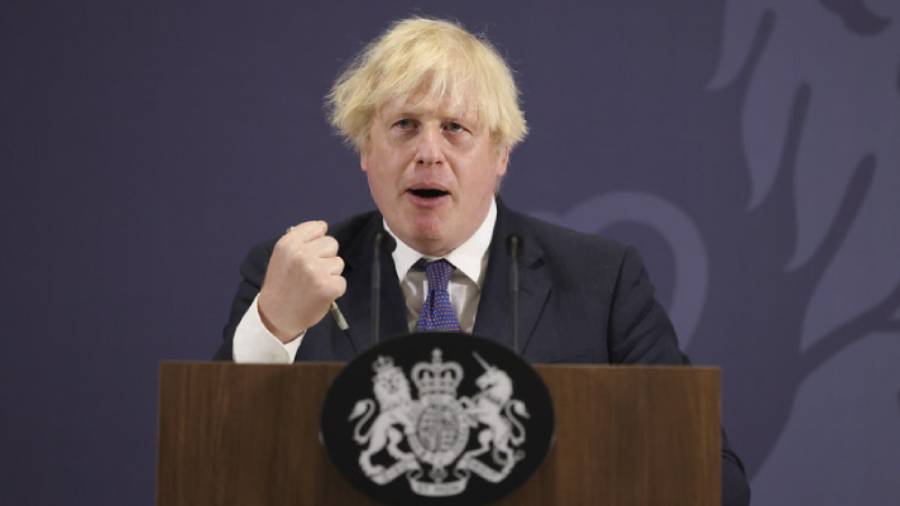

The Prime Minister utilised his keynote speech at the Conservative Party Conference to emphasise the importance of returning to offices, especially for young workers.
Boris Johnson has once again urged workers to return to offices, citing it will be easier for people to learn their roles in-person as opposed to through Zoom.
Speaking to radio station LBC, Mr. Johnson said:
We are certainly encouraging people to get back to work in the normal way.
Get our essential weekday HR news and updates.
And I think that’s a good thing… for young people in particular, it is really essential if you’re going to learn on the job, you can’t just do it on Zoom.
You’ve got to be able to come in and sit at the [desk], know what everybody else is talking about, otherwise you’re going to be gossiped about, and lose out.
You need to be there and you need to have the stimulus of exchange and competition.


In the speech at the Conservative Party Conference, he added that a “productive workforce needs the spur that only comes with face-to-face meetings and water cooler gossip”.
This echoes sentiments made by Chancellor Rishi Sunak earlier this year who stated returning to the office was imperative for young people to learn on the job.
This approach is also hoped to revive cities and town centres which have been hard hit by a lack of footfall due to people working from home.
Prime Minister Johnson’s words come just a day after civil servants were told, by the Conservative Party Chairman Oliver Dowden, to “get off their pelotons and back to their desks”.
Rupert Morrison, CEO of orgvue, a people analytics software company, criticised the Government’s claims:
It’s totally short-sighted and naive to assume that returning to work and a productive Britain are exclusively interrelated.
Location isn’t the only defining factor in driving better productivity and any successful business leader will realise that you can’t apply a blanket approach for every British business.
This view was shared by Andrew Mawson, Founding Director of global consultancy Advanced Workplace Associates, who stated:
The truth is that the Covid-19 has given people an insight into a different life – one with potentially less travel, greater flexibility and a far better work-life balance.
Of course, the experience people have had varies depending upon home facilities, personality, job and social needs, but for the majority the upside of less office time is pretty clear.
Yes, we’re hearing of ‘Zoom Burnout’ and of course people are yearning for social ‘face to face in the same place’ contact. But that can be fixed by organisations and employees shifting to new ways of managing their time and affairs.
The Prime Minister admitted that he did not yet have all of his own staff back in the office but stated that the Cabinet Secretary has written a “pretty good letter” some weeks ago telling everyone to get back to their desks.


Monica Sharma is an English Literature graduate from the University of Warwick. As Editor for HRreview, her particular interests in HR include issues concerning diversity, employment law and wellbeing in the workplace. Alongside this, she has written for student publications in both England and Canada. Monica has also presented her academic work concerning the relationship between legal systems, sexual harassment and racism at a university conference at the University of Western Ontario, Canada.
- Monica Sharma

- Monica Sharma

- Monica Sharma

- Monica Sharma




