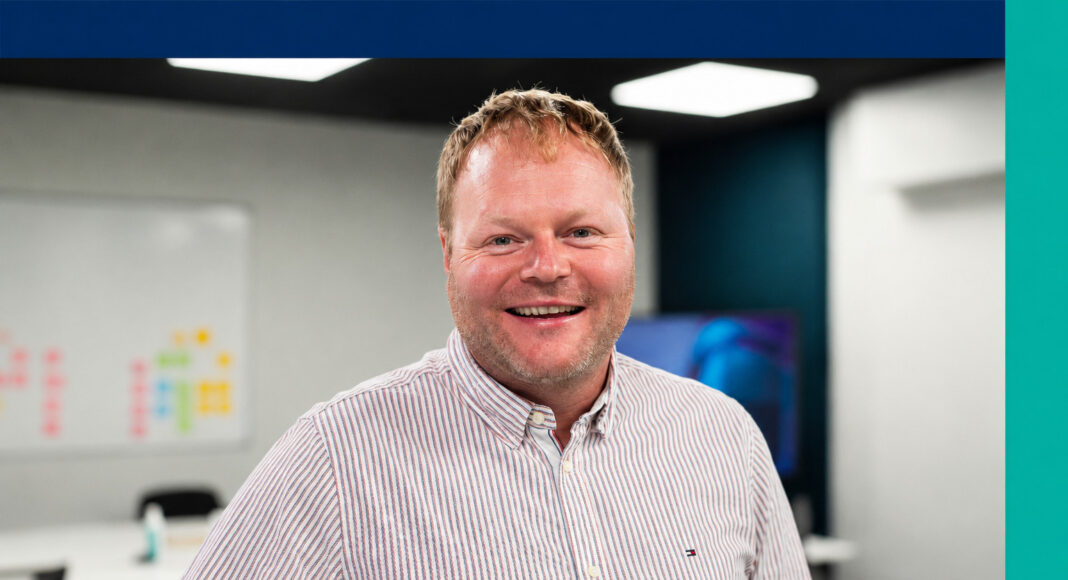

Andrew Finnerty began his career managing teams at McDonald’s before discovering a passion for helping people develop and succeed at work. Now head of people at Creditspring, a fintech company focused on making borrowing simpler and fairer across the UK, he is overseeing recruitment, culture and talent strategy during a period of rapid growth.
Based in London, the 46-year-old has worked across sectors including hospitality, manufacturing, energy, cybersecurity and technology, experiences that have shaped a practical and people-focused approach to leadership. Since joining Creditspring in 2023, his focus has been on scaling the business without losing the culture and sense of purpose that attracted employees in the first place.
He reflects on balancing fast growth with employee wellbeing, building culture in a startup environment and why trust, transparency and human connection remain central to effective HR leadership.
You moved from larger organisations into the startup space to have, as you say, a more direct impact. What differences have you found in building people strategy from the ground up?
For me, the biggest difference has been how immediate everything feels. In a startup, you can see the impact of hiring decisions straight away, across the team, culture, pace and success of the business.
 |
Get our essential weekday HR news and updates.
|

What I’ve really enjoyed is building things with intention from the start, rather than inheriting processes that may not fit. It’s pushed me to be practical, adaptable and really close to what the business needs. That balance of supporting people while helping the company grow is what I’ve found most rewarding.
Creditspring has a clear mission around helping people improve their financial wellbeing. How do you ensure that purpose is reflected in the employee experience?
It starts with making sure the employee experience feels connected to the mission, not separate from it. If we say we are here to improve people’s financial wellbeing, that purpose should shape how we lead, communicate, support and develop our own people too.
That means creating an environment where we have transparency, fairness and genuine care in their day-to-day experience.
I also think purpose becomes real when employees can see how their role contributes to it. So a big part of the People experience is helping teams connect their work back to the wider mission to equip all our members with the knowledge and tools to build their financial resilience and confidence. We begin that process right from the start during the onboarding process and through regular company updates.
As the business grows, how are you balancing rapid recruitment with maintaining a strong and consistent culture?
The key is being really intentional as the business grows. When you’re hiring quickly, it’s easy for culture to become something you talk about rather than something people genuinely experience, so I think you have to protect it very deliberately.
I try to do that at Creditspring by making sure culture is reflected from the very first touchpoint with candidates, not just after they join. It’s not only about finding people with the right skills but people who will add to the environment we’re building.
But I think the most important part comes once people join. A strong culture is built through everyday experiences, from how people are welcomed to how managers show up and how supported people feel in their roles.
“Candidates are evaluating us just as much as we’re evaluating them, so that experience matters.”
You’ve worked across hospitality, manufacturing, energy and tech. What lessons from those sectors have proved most valuable in a fintech environment?
I think working across different sectors has taught me that, while the setting changes, what doesn’t is the need for transparency, trust, leadership and a sense of purpose.
Hospitality has taught me a lot about empathy, pace and how much the day-to-day experience shapes how people feel at work. Manufacturing and energy showed me the importance of consistency, structure and clear communication, especially in environments where there’s a lot of complexity. Tech, then, really highlighted the value of adaptability, because businesses can shift so quickly.
What feels valuable in fintech is being able to bring all of that together. It’s a fast-moving space, but also one where trust really matters. So the most useful lesson has been how to balance a supportive employee experience with the structure and discipline a growing business needs.
Startups often operate with lean teams and high expectations. What steps are you taking to support wellbeing and prevent burnout as the company scales?
Supporting wellbeing has to be built into how the business scales, not added as an afterthought once growth starts to get tough. In a startup, people are often deeply committed, and that’s a real strength. But without the right support, it can also create pressure over time.
What stands out to me at Creditspring is that there’s already strong evidence that the culture is working. Being ranked in The Sunday Times 100 Tech 2026 for the second year running, and seeing that 93% of employees say it’s a great place to work compared with 54% at a typical UK company, suggests we’ve built something genuinely positive.
My focus is on protecting and strengthening that as we grow further. That means making sure managers are having honest conversations about workload and capacity, that priorities are clear and that people feel supported rather than stretched by default.
Preventing burnout is really about keeping ambition high while being just as intentional about people’s wellbeing. If you can do that well, you don’t just protect culture; you make it easier for people to do their best work and stay with the business as it grows.
Hiring in fintech remains highly competitive. What approaches are helping you attract talent in a crowded market?
Honestly, I think the biggest thing working in our favour is that we have a genuinely compelling story to tell. Creditspring exists to make borrowing simpler and fairer for people across the UK, and that kind of purpose resonates with people who want to feel like their work actually means something. In a crowded market, that’s a real differentiator.
Our employer brand has also done a lot of the heavy lifting. Our Glassdoor score is currently 4.7/5, which is outstanding compared to the average of 3.6, representing a positive signal to candidates that this is a place people want to be, and that the culture isn’t just something we put on a careers page.
But I think what ties it all together is the candidate experience itself. From the very first interaction, we try to make sure people get a clear and honest sense of who we are, what we’re building and what it’s actually like to work here. Candidates are evaluating us just as much as we’re evaluating them, so that experience matters. When you get that right, you tend to attract people who are genuinely excited about the mission rather than just looking for any next step.
“People look to founders and senior leaders to understand what is truly valued, so the tone at the top needs to feel clear, consistent and genuine.”
Culture can be easier to define in the early stages of a company, but harder to maintain as it grows. How are you embedding culture in day-to-day operations?
Culture is at its strongest when people experience it in small, everyday moments, not just in the company values on a slide or a wall. As a business grows, that means being really intentional about how culture shows up in how people are welcomed, supported, managed and recognised.
We take opportunities throughout the employee journey, from recruitment through to exit, to reinforce our culture and values in small regular touchpoints. A great example of this would be our Values interview during the hiring process, which everyone has as a final stage to introduce our values to people and ensure it’s a place where they will feel comfortable bringing their best self to and to ensure we feel that person will add further to our great culture.
We then follow this up through our onboarding process, where we share The Creditspring Way with all our new joiners and our CEO Neil (Kadagathur) meets with everyone joining quarterly to talk about where the company came from and how we landed on our culture and values.
A lot of that comes back to managers, because they shape daily experiences. I think it’s important that they feel clear on what good leadership looks like, and that the behaviours we care about are reinforced consistently in how decisions are made and how people work together.
To ensure this, we have a dedicated Slack channel for managers where we all share experiences, hints, tips and best practice that we’ve picked up throughout our careers. In addition we run quarterly sessions with all our managers where we give them the opportunity to suggest topics they aren’t sure about, or something that has changed so we can all discuss it and share knowledge.
Fintech sits at the intersection of finance, technology and regulation. How does that shape your approach to people, skills and organisational design?
What I find interesting about fintech is that it brings together three worlds that do not always naturally move at the same pace: finance, technology and regulation. That creates a really unique environment, because you need people who can be innovative and adaptable, and who also understand the importance of trust, accountability and doing things properly.
That shapes how I think about people and skills. It’s not just about hiring strong specialists but also about building teams who can work well across boundaries, understand the bigger picture and make good decisions in a more complex environment.
Early-stage businesses often rely heavily on leadership behaviour to set the tone, so how do you work with founders and senior leaders to shape the right culture?
Culture starts with leadership behaviour. People look to founders and senior leaders to understand what is truly valued, so the tone at the top needs to feel clear, consistent and genuine.
That’s why working closely with Neil, our CEO, is so important to me. In the early stages of a company, founders have an enormous influence on how the business feels through the standards they set, the way they communicate and the behaviours they model every day. My role is to help translate that into a culture people experience consistently across Creditspring.
“HR will increasingly be shaped by how well we use technology to make People decisions easier.”
Employees increasingly want to feel that their work has a positive impact. How do you connect individual roles to the wider mission of the business?
It’s simply not enough to talk about purpose at a company level, you have to help people understand what that actually means for their role.
A big part of that again is communication. I think it is important that leaders regularly join the dots between the work teams are doing and the wider impact the business is trying to have, so people can see the value of what they contribute.
We do this internally by sharing feedback and experiences from our members. It is really impactful to everyone when we share positive stories that bring to life how we do make a positive difference in people’s lives. This is especially important for those teams that aren’t working directly with our members as it is easy to feel disconnected. Personally I love hearing feedback from our members that highlights what we are doing and the impact it has for them.
Data and metrics are becoming more prominent in HR. How are you using insight to guide hiring and people decisions while keeping the human element front and centre?
Data is there to sharpen judgement, not replace it. It helps me spot patterns in areas like hiring, retention and engagement, so People decisions are based on evidence rather than instinct alone.
That said, the human side still matters just as much. Metrics can tell you what is happening, but not always why, so I think it is important to pair insight with conversations, feedback and context. The best decisions come from using both. Data to guide you, and empathy to make sure the response is right for the people involved.
And finally, how do you see HR evolving over the next five years?
I think HR will increasingly be shaped by how well we use technology to make People decisions easier. The real value is in taking repetitive admin off people’s plates so HR teams and leaders can spend more time on the conversations, context and care that really matter.
In recruitment, for example, we already use AI in our applicant tracking system to record interviews and flag key moments. That makes it easier to review responses, bring in colleagues and make better-informed decisions without adding more admin. I think this will quickly become standard practice, helping improve the speed and quality of hiring while keeping people at the centre of the process.
Ultimately, the goal is to use technology to make HR simpler and more supportive, while keeping empathy, human judgment and genuine connection at the heart of every decision.


William Furney is a Managing Editor at Black and White Trading Ltd based in Kingston upon Hull, UK. He is a prolific author and contributor at Workplace Wellbeing Professional, with over 127 published posts covering HR, employee engagement, and workplace wellbeing topics. His writing focuses on contemporary employment issues including pension schemes, employee health, financial struggles affecting workers, and broader workplace trends.
- William Furney

- William Furney

- William Furney

- William Furney