<

!Google ads have two elements of code. This is the 'header' code. There will be another short tag of code that is placed whereever you want the ads to appear. These tags are generated in the Google DFP ad manager. Go to Ad Units = Tags. If you update the code, you need to replace both elements.> <! Prime Home Page Banner (usually shows to right of logo) It's managed in the Extra Theme Options section*> <! 728x90_1_home_hrreview - This can be turned off if needed - it shows at the top of the content, but under the header menu. It's managed in the Extra Theme Options section * > <! 728x90_2_home_hrreview - shows in the main homepage content section. Might be 1st or 2nd ad depending if the one above is turned off. Managed from the home page layout* > <! 728x90_3_home_hrreview - shows in the main homepage content section. Might be 2nd or 3rd ad depending if the one above is turned off. Managed from the home page layout* > <! Footer - 970x250_large_footerboard_hrreview. It's managed in the Extra Theme Options section* > <! MPU1 - It's managed in the Widgets-sidebar section* > <! MPU2 - It's managed in the Widgets-sidebar section* > <! MPU - It's managed in the Widgets-sidebar section3* > <! MPU4 - It's managed in the Widgets-sidebar section* > <! Sidebar_large_1 - It's managed in the Widgets-sidebar section* > <! Sidebar_large_2 - It's managed in the Widgets-sidebar section* > <! Sidebar_large_3 - It's managed in the Widgets-sidebar section* > <! Sidebar_large_4 - It's managed in the Widgets-sidebar section* > <! Sidebar_large_5 are not currently being used - It's managed in the Widgets-sidebar section* > <! Bombora simple version of script - not inlcuding Google Analytics code* >

Better professional training would boost skills and job creation, says OECD

-

Countries should step up their efforts to improve the quality of post-secondary vocational training in order to meet the changing needs of today’s job market, according to a new OECD report.

Skills Beyond School: Synthesis Report says that most basic vocational courses cannot teach the higher level skills needed in an increasing number of jobs in fast-growing sectors, such as healthcare technicians and junior managers.

In the United States, for example, it is estimated that one third of all vacancies by 2018 will call for some post-secondary qualification, but not necessarily the completion of a four-year degree.

But while some countries have thriving post-secondary vocational sectors, others have found it difficult to find a place for shorter one-or two-year programmes in competition with better known academic qualifications.

England and Northern Ireland stand out as countries where, relative both to other countries and to potential demand, there is limited provision of postsecondary vocational training, potentially leading to a shortage of mid-level skills.
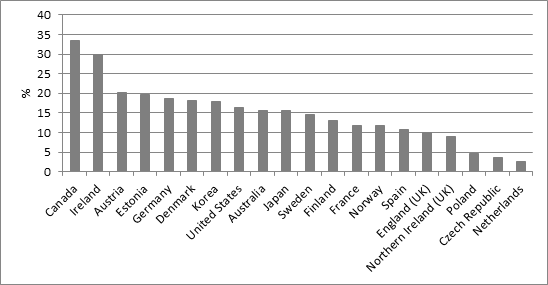
 

Professional education and training qualifications in the labour force
Professional education and training* qualifications in the labour force.Percentage of adults aged 20-45 who have short-cycle postsecondary vocational education and training as their highest qualification 


Download the underlying data


The OECD study outlines a series of recommendations for countries to help them step up their efforts to deliver higher quality post-secondary vocational programmes. These include:

  • All professional education and training programmes should include some work-based learning as a condition of receiving government funding. This work-based learning should be systematic, quality-assured and credit-bearing.
  • Ensure that the workforce in professional training institutions benefit from a strong blend of pedagogical skills, industry experience and academic knowledge. Adapt qualification requirements to that end.
  • Assess students’ basic skills at the start of programmes and integrate basic skills development into professional programmes. This will ensure students leave programmes with essential literacy and numeracy skills that the 2013 OECD Survey of Adult Skills revealed that many adults lacked.
  • Engage industry stakeholders and develop and sustain vocational systems in close partnership with those stakeholders. This is key as work-based learning is too often weak and unsystematic, and employers and trade unions are sometimes too remote from the development of qualifications, so that they end up having limited value in the labour market.

Latest news

Noisy and stuffy offices linked to lost productivity and retention concerns

UK employers are losing more than 330 million working hours each year due to office noise, poor air quality and inadequate workplace conditions.

Turning Workforce Data into Real Insight: A practical session for HR leaders

HR teams are being asked to deliver greater impact with fewer resources. This practical session is designed to help you move beyond instinct and start using workforce data to make faster, smarter decisions that drive real business results.

Bethany Cann of Specsavers

A working day balancing early talent strategy, university partnerships and family life at the international opticians retailer.

Workplace silence leaving staff afraid to raise mistakes

Almost half of UK workers feel unable to raise concerns or mistakes at work, with new research warning that workplace silence is damaging productivity.
- Advertisement -

Managers’ biggest fears? ‘Confrontation and redundancies’

Survey of UK managers reveals fear of confrontation and redundancies, with many lacking training to handle difficult workplace situations.

Mike Bond: Redefining talent – and prioritising the creative mindset

Not too long ago, the most prized CVs boasted MBAs, consulting pedigrees and an impressive record of traditional experience. Now, things are different.

Must read

Poppy Jaman: Taking a whole organisational approach to mental health

Each year around ten million adults in the UK will experience mental ill health, meaning one in four of us will experience a mental health issue at some point in our lifetime. Poppy Jaman, CEO of Mental Health First Aid (MHFA) England, shares her thoughts on how employers can take a whole organisation approach to mental health.

Emilie Bennetts: Misconduct outside work – a fair dismissal?

Gross misconduct in the workplace or during working time...
- Advertisement -

You might also likeRELATED
Recommended to you

Exit mobile version




