

The pace of wage growth across the UK has slowed, with the latest figures showing the median pay award has dropped to its lowest point in nearly four years.
Analysis by London-based firm Incomes Data Research (IDR) released on Monday found that the median pay award in the three months to July 2025 stood at 3 percent, down from 3.4 percent in the previous quarter. It’s the first time the median has been at 3 percent since December 2021.
The fall reflects a sharp decline in the proportion of employers offering higher settlements. Less than one in 10 awards (9 percent) were worth 4 percent or more, compared with 39 percent in June. Over half of all settlements (53 percent) fell within the 3 to 3.99 percent range, a marked increase from 35 percent the previous month.
Private sector drives slowdown
The latest IDR figures are drawn from a sample of 32 pay awards covering nearly 684,000 employees. They show that the downturn is most evident in the private sector, where the median also fell from 3.4 percent to 3 percent. Just 7 percent of private sector awards reached 4 percent or more in the three months to July, compared with 38 percent in June.
 |
Get our essential weekday HR news and updates.
|


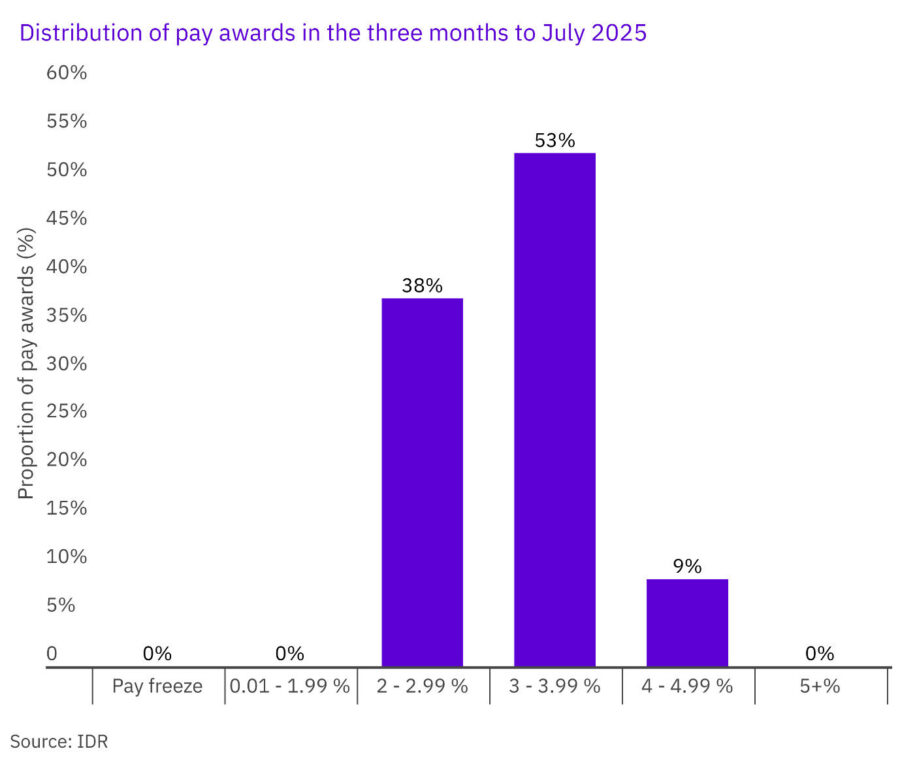
Construction, financial services and hospitality were among the sectors where pay rises between 3 and 3.99 percent were most common. IDR noted that very few of the July data points came from the public sector, meaning the results reflect almost entirely private sector settlements.
April remains the most common month for annual settlements, and this year’s April figures were boosted by a 6.7 percent rise in the National Living Wage. IDR said the median pay award for the three months to April was 3.5 percent, slightly higher than now.
Zoe Woolacott, a senior pay researcher at IDR, said April was “by far the most popular month for pay setting so the latest median is somewhat less representative of the overall landscape than trends established earlier in the year”.
Pay awards diverge from earnings growth
The Office for National Statistics (ONS) reported regular pay growth of 5.6 percent in the year to May 2025, a figure significantly higher than the 3 percent median pay award recorded by IDR. The gap illustrates the difference between average earnings growth, which includes factors such as bonuses, overtime and changes in workforce composition, and annual pay settlements, which reflect the base pay increases employers grant through collective or company-wide reviews.

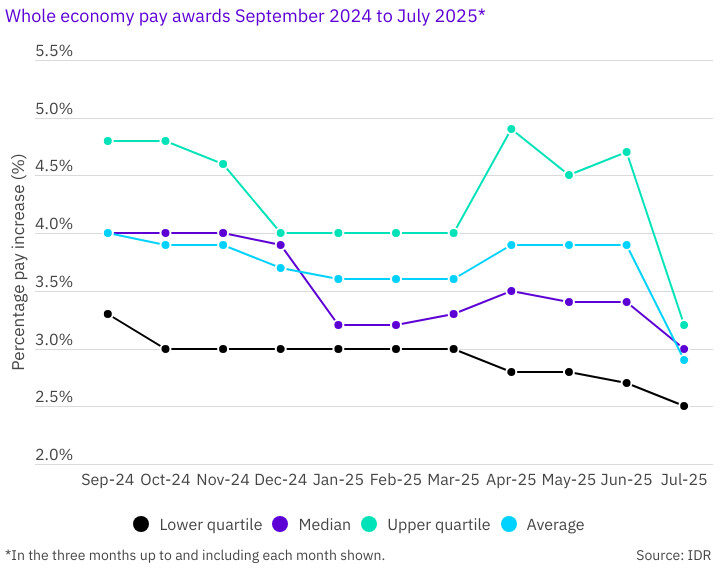
IDR has previously stressed that pay award data offers a clearer picture of what most employees actually receive in terms of annual increases, while the ONS average earnings figures can be distorted by short-term business activity or staff turnover.
Inflation and economic pressures
The slowdown in settlements comes as inflation continues to ease from its peaks in 2022 and 2023. The Consumer Prices Index rose by 2.2 percent in July, close to the Bank of England’s 2 percent target. Falling energy costs and more stable food prices have helped reduce pressure on employers to match wage increases to inflation.
But economists warn that lower pay awards could weigh on consumer spending. While average wages are now rising faster than prices, many households are still struggling with high mortgage repayments and rent increases, limiting the benefit of recent real-terms pay growth.
Employers, meanwhile, remain cautious about committing to higher awards amid sluggish economic growth. The Office for Budget Responsibility has forecast GDP growth of just 0.9 percent for 2025, with productivity gains still weak across much of the economy.
Sectoral contrasts
Construction employers, grappling with skills shortages, were among those more likely to grant pay rises above 3 percent. In financial services, where profits have held up despite market uncertainty, settlements clustered around 3.5 percent. Hospitality, still competing to recruit and retain staff post-pandemic, also tended towards awards in the 3 to 3.99 percent range.
By contrast, manufacturing and retail showed weaker settlement levels, reflecting tighter margins and subdued demand. Public sector pay is not fully captured in the latest sample, but earlier in the year government deals delivered above-average awards in some areas, particularly health and education.
The change has practical implications for pay planning, retention and employee relations. At a time when inflation is easing, lower awards may be easier to justify, but they risk demotivating staff who saw higher increases in 2022 and 2023 as organisations responded to the cost-of-living crisis.
Unions are likely to seize on the slowdown as evidence that employers are failing to share productivity or profit gains. The Trades Union Congress has already warned that many workers remain worse off in real terms than before the pandemic.
Employers also face renewed pressure to balance affordability with the need to compete for talent in tight labour markets. Even with unemployment at 4.4 percent, shortages in key sectors mean organisations must remain alert to the risk of losing skilled staff to better-paying rivals.
Outlook for the rest of 2025
IDR expects the median pay award to remain close to 3 percent through the rest of the year, barring any major economic shocks. With inflation forecast to stay around the Bank of England’s target, the need for large settlements has diminished.
But while the figures suggest a return to pre-pandemic norms, the labour market remains volatile. The Employment Rights Bill, due later this year, could also reshape employer obligations, with possible effects on negotiations and settlement levels.
For now, the latest data shows that the exceptional pay pressures of the last two years are receding. The challenge for employers, observers say, is to ensure that lower settlements do not undermine engagement at a time when productivity and morale are critical to recovery.


William Furney is a Managing Editor at Black and White Trading Ltd based in Kingston upon Hull, UK. He is a prolific author and contributor at Workplace Wellbeing Professional, with over 127 published posts covering HR, employee engagement, and workplace wellbeing topics. His writing focuses on contemporary employment issues including pension schemes, employee health, financial struggles affecting workers, and broader workplace trends.
- William Furney

- William Furney

- William Furney

- William Furney