

The UK may offer a respectable 28 days of statutory paid annual leave, but it lags far behind many countries on paid public holidays. According to a new global comparison, the UK is one of only five nations that do not guarantee paid leave on public holidays by law.
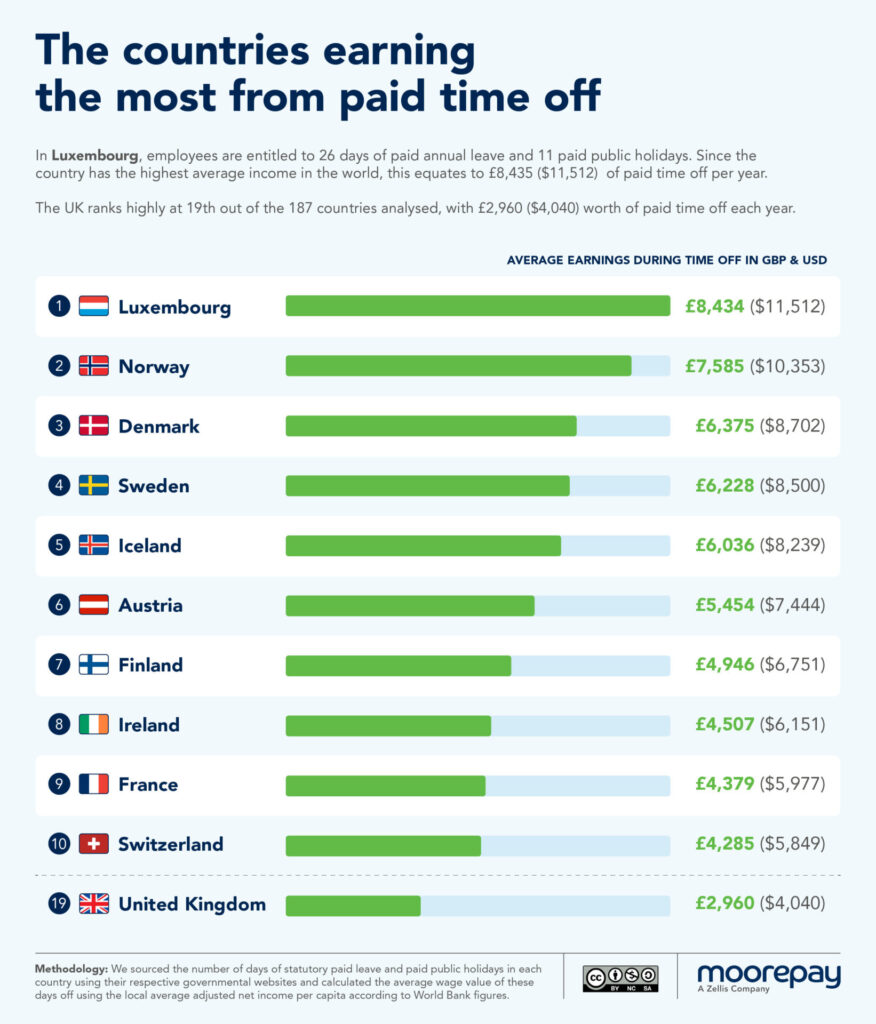
The study, by HR and payroll provider Moorepay, analysed statutory paid time off across 187 countries, found that the UK’s overall leave package puts it in 19th place when measured by how much that time off is worth in monetary terms. For a UK worker on the average salary, annual leave equates to just under £3,000.
By contrast, employees in countries such as Luxembourg, Norway and Sweden receive not only more generous paid time off allowances but also far higher earnings during that leave. Luxembourg tops the list, with workers effectively earning £8,434 during their annual statutory leave.
UK’s lack of paid bank holiday provision out of step with Europe
The report highlights that UK employees are entitled to 28 days of paid annual leave, but there is no statutory requirement for employers to pay staff on public holidays. It is up to individual employers whether to include bank holidays within the 28-day entitlement or offer them in addition.
 |
Get our essential weekday HR news and updates.
|

This puts the UK at odds with most European countries, where public holidays are paid separately and do not reduce annual leave. Austria, for example, offers 30 days of paid annual leave and 13 paid public holidays, while France guarantees 30 days of leave and 11 public holidays.
How the UK compares globally
The study found the most generous overall paid leave packages in Yemen, Libya and Bahrain, where workers are entitled to more than 44 days of paid time off each year. Meanwhile, the United States remains the only country in the world with no statutory paid leave or public holiday provision.

The UK’s 28 days of annual leave is among the better offers globally but falls short in total days off when factoring in unpaid public holidays. In total time off, the UK ranks near the bottom of the European table.
Implications for HR leaders and people policy
For UK HR leaders, the findings raise important questions about how their organisations structure and communicate time off entitlements. With no legal requirement to pay for public holidays, many employers choose to incorporate bank holidays into annual leave, which can create confusion and leave employees feeling short-changed.
Moorepay’s research suggests that clarity, fairness and competitiveness should be central to how leave policies are designed.
Valuing time off as part of the total reward package
With rising focus on wellbeing, work-life balance and flexible working, time off is increasingly viewed as a key component of the employee value proposition. Moorepay’s analysis shows that in monetary terms, the average UK worker ‘earns’ £2,960 during their paid leave, a figure that is well behind many European neighbours.
HR leaders looking to benchmark or enhance their time-off policies can use the study as a reference point to compare statutory provisions across countries and understand where the UK stands.
The study compiled statutory paid leave and public holiday entitlements from official government sources in 187 countries. All figures were converted into working days, assuming a five-day week, and cross-referenced with adjusted net income per capita from the World Bank.


William Furney is a Managing Editor at Black and White Trading Ltd based in Kingston upon Hull, UK. He is a prolific author and contributor at Workplace Wellbeing Professional, with over 127 published posts covering HR, employee engagement, and workplace wellbeing topics. His writing focuses on contemporary employment issues including pension schemes, employee health, financial struggles affecting workers, and broader workplace trends.
- William Furney

- William Furney

- William Furney

- William Furney