
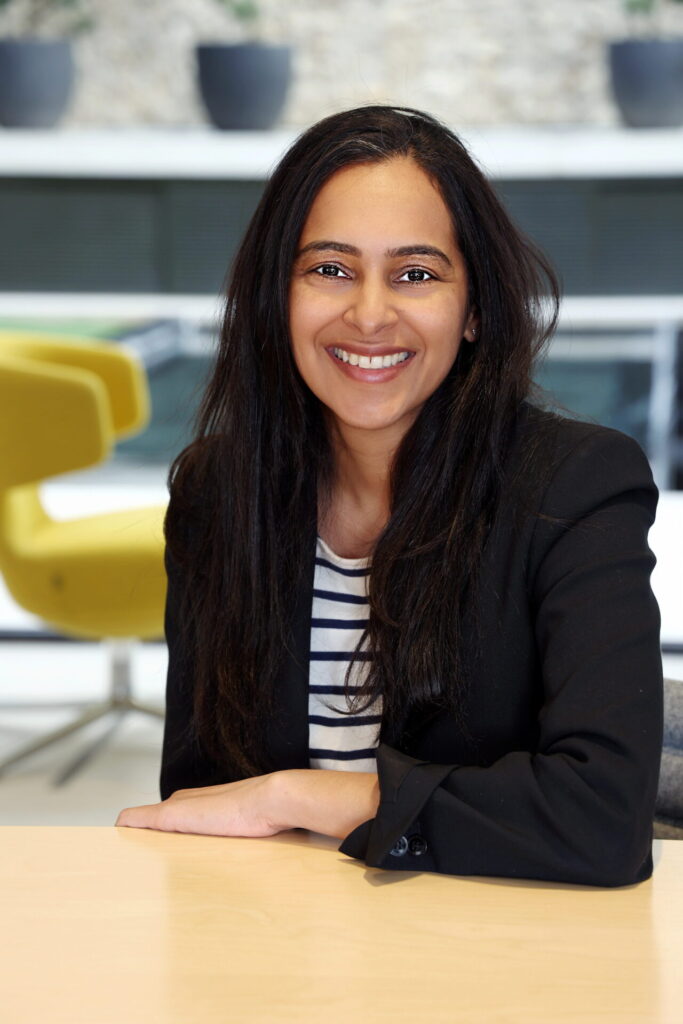
After nearly two decades abroad, including stints in Singapore and the United States, Shabrina Jiva Grande returned to her native France to take on a senior leadership role at Linedata, a global fintech company founded by her father and listed on the Paris stock exchange. Now based in the French capital and working across its global offices, she leads as head of people and transformation, bringing together her expertise in strategy, coaching and business change.
The 44-year-old lives in the French capital with her husband Sylvain and their five-year-old son Arman, who still holds her hand on the school run — a small but cherished part of her daily rhythm. Shabrina starts each day not with emails or meetings but a 21-minute meditation practice she has followed faithfully since her New York days, setting the tone before she shifts into work mode during her Métro commute.
From advising senior leaders to listening to colleagues across continents, she balances transformation and empathy with a calm, structured approach. Evenings are often spent with her family or catching up with visiting relatives, while voluntary work and philanthropy are close to her heart.
I am not a morning person, so every night before bed, I check my schedule and figure out the latest possible time I can wake up. On weekdays, that usually means setting my alarm for somewhere between 7 and 7:30.
 |
Get our essential weekday HR news and updates.
|

My mornings revolve around three things. First is a 21-minute meditation routine introduced to me 10 years ago by a friend in New York. It’s a mix of light movement, breathing and chanting, designed to align mind, body, heart and spirit. Someone once gave me the metaphor of a car: when all four wheels are aligned, it moves smoothly. That stayed with me.
The second is spending time with my son: morning snuggles, getting him ready and, when I can, walking him to school. He is still excited to hold my hand, and I tell him every day that it’s one of my favourite things in the world.

I don’t really start thinking about work until I leave the house. It’s once I start my commute that I begin shifting into work mode. The commute is a mix of walking and the Métro, about 15 minutes each. I enjoy the walk. It helps me start the day grounded and with a bit of movement. I used to listen to podcasts, but over the past year I have preferred the quiet, just noticing my surroundings, breathing the air and being present.
Once on the Métro, I use the time to catch up, reading the New York Times newsletter and going through my emails. Since we have colleagues in the US, things can happen overnight, and it helps me know what might need attention that day.
When I get to the office, the first thing I do is make tea. I have several boxes in my drawer and pick the one that inspires me that day. While I have my tea, I look through my schedule, which is usually quite back-to-back, and make a list of my priorities for the day. If something new has come up, I might need to reshuffle. I break things down by the different hats I wear: People, Strategy and Transformation, and my role on the executive team.
There are really two types of days: the ones when I am in Paris at our headquarters and the ones when I am travelling to visit our offices in India, the US, Tunisia, the UK, Portugal, Latvia or Hong Kong.
When I am in Paris, my time is split between working with other members of the executive team, collaborating with my teams, including the local HR leaders in my HR leadership group, and moving things forward on our various projects. I often meet candidates as well, which I really enjoy. We also regularly host colleagues visiting from other offices.
When I travel, I plan the agenda carefully in partnership with the local teams so we can make the most of the visit. It’s a mix of connecting with people, leaders, managers and team members, and going deeper on topics that are specific to their business or region, so we can advance the work that is most relevant to them. I try to meet as many people as possible and hear all the voices of the company. I believe that in HR, our role is to represent all of them.
Coming back to mornings, whenever possible, I try to schedule working sessions that involve brainstorming or creative thinking earlier in the day, as I tend to be more productive with that kind of work in the morning. But with teams across the world, especially in the US, that’s not always possible.
Either I eat at my desk or have a work lunch; it depends on the day. The habit of eating while working definitely comes from my 15 years in the US. One unique thing, though, is that my work lunches can include my dad or my brother — one of the benefits of working with family.
I think AI is going to impact us in so many ways. First, it will change how we do and deliver HR, and our employees will expect the same level of convenience and personalisation they experience in the rest of their lives.
Second, it will impact all the people we support, from business leaders to every employee, as they think about how AI changes their tasks, their roles or even their business strategy.
For me, the real innovations in HR will be the ones that enable us to support both the company and individuals through this massive, fast-moving transformation. Helping people adjust, build the right skills, stay focused and not lose the human connection along the way.
One piece of advice I give to my HR directors is to create a simple system to gradually meet everyone in their scope, across roles and levels. Even short one-to-one conversations, just 30 minutes, can be powerful. Ask people what they actually do, what is top of mind for them, what their goals are, what feels challenging right now and how we can help.
This builds a much deeper understanding of how the company works and what people are really trying to get done. I’ve seen it sharpen people’s perspective and judgment and make them more effective in how they support our teams. It also builds stronger connection and trust, on both sides.
My afternoons are quite similar to my mornings, just a little longer, with a couple more hours to get things done, so often more productive. One of the most important aspects of my job, both in the afternoons and throughout the day, is listening. Whether it’s a scheduled meeting or a spontaneous conversation, I try to create space for people to share what’s on their mind. It’s important because every voice matters, people have valuable things to say and that’s the only way we can succeed together. Listening is the heart of my job. My best days are the ones where I get to connect with people at that level. The hardest days are when I’m too busy for those kinds of interactions.
I need something sweet around 5pm. I’ve definitely stayed a child in that way. It’s my version of a goûter to keep going. If I’m feeling tired, I walk around the office and chat with people for a few minutes. That gives me a boost.
Two other things help me, especially when I’m tired or having a harder day. If something in particular is weighing on me, I take a few minutes to breathe, notice where I feel tension in my body and write things down: bullet points with the concern, questions I have, possible scenarios and what I can actually do. It brings immediate clarity and calm.
And when I’m physically tired, especially when travelling or jet-lagged, I do yoga nidra. It’s a guided deep relaxation practice that lasts about 20 minutes and is incredibly restorative. I always feel much more rested afterwards.
What bothers me most is when we go through HR processes and lose sight of the original “why” behind them. I often tell my team that we don’t need to add more things every year. Sometimes it’s useful, but the way forward is not about to pile on more. It’s better to do the same things, or even less, and make sure everything we do is connected to its purpose and done with meaning and impact. It takes discipline to apply that “why” discipline, but with it, we can have real impact.
With travel and working across time zones in a global company, it’s not easy to have a set schedule. For me, it’s less about strict boundaries and more about making it all fit together in a way that works. I work after hours when I need to, especially to get back to people or move things forward, and I try to balance that so it stays manageable.
My commute home is the same combination of Métro and walking, and it helps me transition out of work mode. I usually get home just in time to say goodnight to my son. We have a little ritual where we share what we’re grateful for that day, who we love and what we need help with or are worried about — like if someone is sick, for example. That five-minute conversation is a moment of connection, slowing down and reflecting. Even if I regularly pick work back up later in the evening, it really grounds me.
Sometimes I finish up work after my son is asleep. In the evenings, we often watch movies together. We also frequently have friends or family staying with us in Paris, so some of the best evenings are just spent catching up and chatting at home.
We try to do a couple of cultural things each month. Paris has an incredible range of theatres and events. Voluntary work is also important to me, so that can take up one evening a week as well. One thing that might surprise people is how important philanthropy work is to me at Linedata. It keeps me connected to my values and to making a real difference in society. Last year, I was honoured to lead a delegation of colleagues to Kenya and Uganda, where we saw firsthand the incredible work being done to improve healthcare and education in East Africa. Supporting projects like this, whether through company initiatives or time spent volunteering, is a privilege and a reminder of the bigger picture behind what we do every day.
Spending time with my son makes it easy to be present and step out of work mode, though I sometimes still find myself thinking about work during the week. Watching a movie with my husband or spending time with friends also helps me disconnect. For me, weekends are when I really recharge and take a break from work.
I’m definitely an evening person. For me, if it’s not midnight, it feels too early to go to bed; it’s almost psychological. I like to read a little before I sleep, usually poetry or something spiritual. It helps me step out of day-to-day thoughts and puts things in perspective.
I’m blessed to fall asleep easily most nights. My last thoughts are often a mix of my husband and a prayer I start reciting in my head. I usually fall asleep in the middle of it.


William Furney is a Managing Editor at Black and White Trading Ltd based in Kingston upon Hull, UK. He is a prolific author and contributor at Workplace Wellbeing Professional, with over 127 published posts covering HR, employee engagement, and workplace wellbeing topics. His writing focuses on contemporary employment issues including pension schemes, employee health, financial struggles affecting workers, and broader workplace trends.
- William Furney

- William Furney

- William Furney

- William Furney