


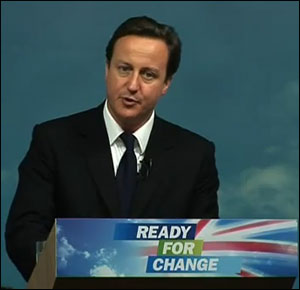
David Cameron has said that the “all-pervasive rules culture” is one of the most infuriating things about living in Britain.
Speaking to the Policy Exchange, he made it clear that the Conservatives will reduce the burden and impact of health and safety legislation – and that it will be done in a responsible and sober way.
In developing that approach he said the Conservatives will do two things:
- Establish clear and specific principles about when health and safety legislation is appropriate, and when it is not, so we can evaluate whether existing or future legislation is necessary.
- Propose practical changes in the law to both bring an end to the culture of excessive litigation while at the same time giving legal safeguards to those who need them most.
 |
Get our essential weekday HR news and updates.
|

 Mr Cameron said: “Something has gone seriously wrong with the spirit of health and safety in the past decade. When children are made to wear goggles by their head teacher to play conkers. When trainee hairdressers are not allowed scissors in the classroom. When office workers are banned from moving a chair without supervision. When staff at a railway station don’t help a young mum carry her baby buggy because they are not insured. When village fêtes are cancelled because residents can’t face jumping through all the bureaucratic hoops.
“What began as a noble intention to protect people from harm has mutated into a stultifying blanket of bureaucracy, suspicion and fear covering the actions of millions of individuals as they go about their daily lives.”
He cited the death of Jordon Lyon in September 2007 as an example, saying the 10-year-old had “drowned in a pond, having rescued his young sister, because officers were told not to intervene as they hadn’t undertaken their ‘water rescue’ health and safety training”.
Mr Cameron insisted the biggest cause of the UK’s health and safety culture was the “perception” that “behind every accident there is someone who is personally culpable, someone who must pay”.
We see it in those adverts on television, which say that if you’ve suffered some fall or mishap you can take legal action without much cost.
“We see it in the commercialising of lawyers’ incentives to generate litigation, through the system of enhanced success fees and referral fees which has led to a growth in ‘ambulance-chasing’.”
However, Ruth Doyle, of the Institution of Occupational Safety and Health, denied that legislation was the problem. She blamed widespread misunderstanding of the rules and also claimed that Mr Cameron was in danger of “muddling myths, generalisations and fact”.
She said: “David Cameron is retelling some of the myths in order to highlight the issue. The politicians should query them if we are to tackle the issue.”
There had been only one case, five years ago, of a teacher at a primary school asking children to wear goggles while playing conkers, she claimed.
Cameron also announced that Lord David Young will lead an extensive review for the Party with a focus on some specific questions:
- How can we best protect what are effectively ‘Good Samaritans’? Is it possible to extend legal protection for all people acting in good faith – especially public service professionals?
- How can we help alleviate some of the health and safety oversight that currently burdens small, local and voluntary organisations? At the moment if their work benefits the local council they fall under health and safety law.
- Civil Liability Act – do we need to define civil liability for negligence in statute? At the moment there is no single Act of Parliament that ties all this work together. Lord Young will examine whether such an Act would be necessary and effective in reducing our excessive health and safety culture.
ÂÂ


Paul Gray is an entrepreneur and digital publisher who creates online publications focused on solving problems, delivering news, and providing platforms for informed comment and debate. He is associated with HRZone and has built businesses in the HR and professional publishing sector. His work emphasizes creating industry-specific content platforms.
- Paul Gray

- Paul Gray

- Paul Gray

- Paul Gray



