<

!Google ads have two elements of code. This is the 'header' code. There will be another short tag of code that is placed whereever you want the ads to appear. These tags are generated in the Google DFP ad manager. Go to Ad Units = Tags. If you update the code, you need to replace both elements.> <! Prime Home Page Banner (usually shows to right of logo) It's managed in the Extra Theme Options section*> <! 728x90_1_home_hrreview - This can be turned off if needed - it shows at the top of the content, but under the header menu. It's managed in the Extra Theme Options section * > <! 728x90_2_home_hrreview - shows in the main homepage content section. Might be 1st or 2nd ad depending if the one above is turned off. Managed from the home page layout* > <! 728x90_3_home_hrreview - shows in the main homepage content section. Might be 2nd or 3rd ad depending if the one above is turned off. Managed from the home page layout* > <! Footer - 970x250_large_footerboard_hrreview. It's managed in the Extra Theme Options section* > <! MPU1 - It's managed in the Widgets-sidebar section* > <! MPU2 - It's managed in the Widgets-sidebar section* > <! MPU - It's managed in the Widgets-sidebar section3* > <! MPU4 - It's managed in the Widgets-sidebar section* > <! Sidebar_large_1 - It's managed in the Widgets-sidebar section* > <! Sidebar_large_2 - It's managed in the Widgets-sidebar section* > <! Sidebar_large_3 - It's managed in the Widgets-sidebar section* > <! Sidebar_large_4 - It's managed in the Widgets-sidebar section* > <! Sidebar_large_5 are not currently being used - It's managed in the Widgets-sidebar section* > <! Bombora simple version of script - not inlcuding Google Analytics code* >

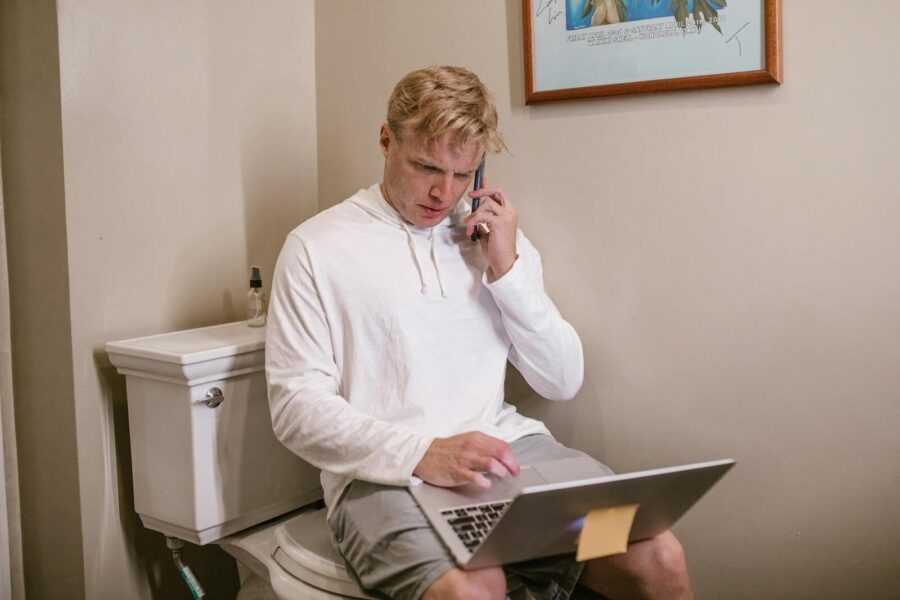
‘Boundary collapse’: 6 in 10 UK workers send work emails from the loo

-

That’s according to research by HR software provider Personio, which found that 65 percent of workers have completed a full working day without taking a break, while 60 percent admitted to responding to emails or calls from the bathroom.

Millennials were the most likely to work while unwell (58%) and to send emails from the bathroom (64%), while Gen Z workers (aged 18–24) were the most likely to skip breaks in order to leave work earlier.

Women appear disproportionately affected, with 60 percent saying they work through their lunch break, compared to 50 percent of men. Law enforcement and security workers reported the highest rates of working a full day without a break, at 76 percent.

Erosion of boundaries and psychological safety

Commenting on the findings, psychotherapist and workplace behaviour specialist Zoë Aston said, “People working from the bathroom is a red flag for boundary collapse. The bathroom is one of the few remaining personal spaces we expect to be off-limits. When employees are responding to work in that space, it signals a culture where people don’t feel psychologically safe to disconnect, even briefly.”

Aston added that the gender difference in break-taking raises important issues around equity and workplace culture.

“Women are often conditioned to over-deliver in professional environments – taking fewer breaks, shouldering invisible labour, and deprioritising their own wellbeing to meet (or exceed) expectations. For HR leaders, this is a call to go beyond policy and examine if they are fostering equity in rest, recovery, and workload distribution.”

Break culture and wellbeing

The data also highlighted gaps in basic knowledge of working rights. Nearly one in three workers (31%) did not know they are legally entitled to a 20-minute uninterrupted break when working more than six hours a day.

Suzie Rogers, VP, People Business Partnering at Personio, said, “Prolonged screen time without rest can lead to eye strain, headaches and musculoskeletal issues, as well as anxiety, chronic stress, sickness and ultimately burnout, all of which come at a much steeper cost to both employees and organisations.”

Rogers added, “Taking regular breaks isn’t just about boosting productivity, it’s about protecting long-term health and wellbeing. Whether that involves stepping away from your desk or switching off at lunch, even short pauses can make a big difference.”

Latest news

Turning Workforce Data into Real Insight: A practical session for HR leaders

HR teams are being asked to deliver greater impact with fewer resources. This practical session is designed to help you move beyond instinct and start using workforce data to make faster, smarter decisions that drive real business results.

Bethany Cann of Specsavers

A working day balancing early talent strategy, university partnerships and family life at the international opticians retailer.

Workplace silence leaving staff afraid to raise mistakes

Almost half of UK workers feel unable to raise concerns or mistakes at work, with new research warning that workplace silence is damaging productivity.

Managers’ biggest fears? ‘Confrontation and redundancies’

Survey of UK managers reveals fear of confrontation and redundancies, with many lacking training to handle difficult workplace situations.
- Advertisement -

Mike Bond: Redefining talent – and prioritising the creative mindset

Not too long ago, the most prized CVs boasted MBAs, consulting pedigrees and an impressive record of traditional experience. Now, things are different.

UK loses ground in global remote work rankings

Connectivity gaps across the UK risk weakening the country’s appeal to remote workers and internationally mobile talent.

Must read

Andrew Harvey: HR & Comms, where’s the line?

Andrew Harvey discusses how HR can collaborate with its PR teams to ensure better communication with its employees and help to improve employee engagement within the company.

Alex Graves: Why HR data has ‘colossal power’

Modern society is driven by data, writes Alex Graves. In fact, people create about 1.7 MB of it every second. Used wisely, it has colossal power.
- Advertisement -

You might also likeRELATED
Recommended to you

Exit mobile version