


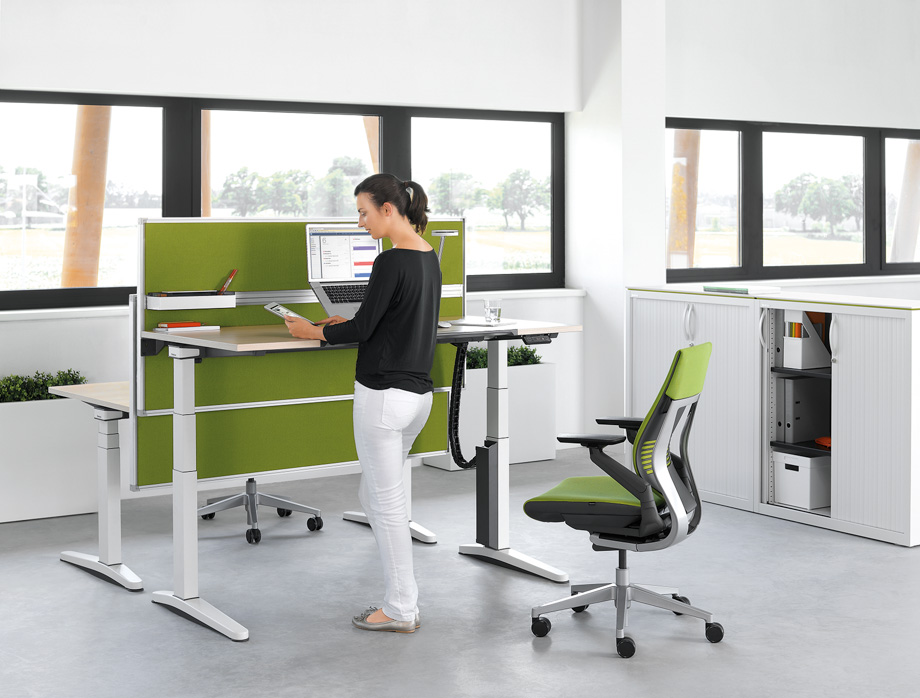
Steelcase, the global leader in the office furniture industry, is celebrating a desking system which highlights the benefits to office workers of working standing up rather than remaining seated at their desks all the time.
Steelcase have designed Ology, a desking system which plays a key role in helping to create a health conscious working environment.
Ology is the first desking solution that supports the physiology and biology of users and promotes posture change through its five different height adjustment settings.
 |
Get our essential weekday HR news and updates.
|

Recent independent research has showed that office workers who sit all the time are more prone to anxiety and depression and standing up for short periods of time can improve health in the long term.
According to a recent study by scientists at Strathclyde University, Glasgow, people who spend more than eight hours a day in a chair during the working week are more than twice as likely to be anxious and four times as likely to be depressed.
Desk-bound staff who take the trouble to get up and walk about, even for the briefest of periods, reported feeling much healthier.
The Strathclyde study findings, researched by Dr Mike Loosemore, head of Exercise Medicine at University College Hospital, who told the BBC Today programme that small amounts of regular physical activity, like standing up and walking short distances, can improve health in the long term and reduce risks of high blood pressure, heart disease and even cancer.
Dr Loosemore said: “It is important to remember that every movement is an active one. In other words, even the smallest increase in activity during your working routine can have long-term benefits to your health.”
Physical wellbeing is a major challenge and a key issue is that workers do not change postures enough during the working day. Changing posture helps energy levels, improves productivity, helps prevent weight gain and cardiovascular diseases and reduces musculoskeletal discomfort.
Bostjan Ljubic, vice president Steelcase UK and Ireland said: “This research underpins existing studies which highlight the benefits of moving around at work and adopting a range of postures which is vitally important to employees’ overall wellbeing. These insights were integral to the design of Ology.”
Mr Ljubic added: “Ology offers two user interface options (intuitive and programmable): With the push of a button the desk will raise to an average standing height and facilitate shoulder to shoulder collaboration. Not only it is more comfortable and convenient, it is proven more effective and also gives users one more reason to stand.” In addition, the soft edge profile reduces shoulder and neck fatigue during lengthy computer use.”
Ology also addresses the spread of germs in the workplace and plays a key part in improving employees’ wellbeing.
Ology is the first Steelcase product to be designed and manufactured with the option of antimicrobial components that inhibit the growth of micro-organisms and prevent the spreading of harmful bacteria.


