


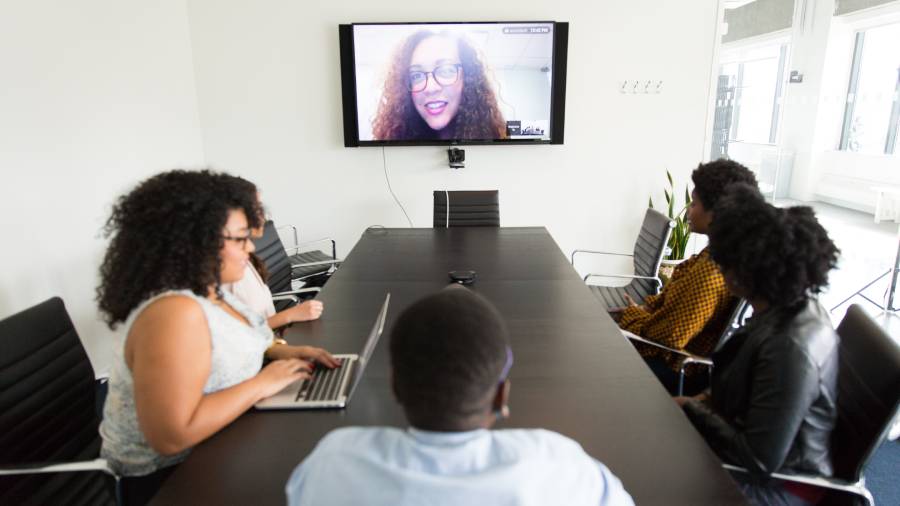

Over 80 per cent of the top UK firms have rejected the idea of bringing back staff full-time to the office, largely favouring a hybrid approach instead.
The vast majority of the top 50 firms in the UK have decided not to make it mandatory for staff to return to the office full-time, instead embracing a combination of homeworking and in-person working.
The survey by the BBC also revealed that a further four were keeping their decision under review, indicating that around 47 of the companies could be adopting a new work model after restrictions are lifted.
This decision to choose a hybrid work model will impact over a million workers in the UK.
 |
Get our essential weekday HR news and updates.
|

However, the firms have made it clear that navigating a mix of work and in-person working will not be without its challenges.
One such challenge is the decision to decide whether to retain office space and if not, how much to cut down on. Companies such as Lloyd’s Banking Group have announced they will be cutting around a fifth of office space by 2023 whilst HSBC said it is planning to reduce almost half (40 per cent).
However, with the uncertainty surrounding the virus and its mutations, many are holding off from asking staff to return – making it difficult to judge how much office space the company will really need.
This could pose other problems for cities with Chancellor Rishi Sunak strongly pushing for a return to offices. Mr. Sunak had previously stated he is “firmly in the camp” of seeing a return to offices, in order to retain company culture and ensure the survival of businesses which rely on people commuting such as cafes or restaurants.
Another issue for companies may be how to actually create equal opportunities for teams when some may choose to return and others intend to work remotely long-term.
According to a recent survey by PUSH, this is an acute fear for workers with almost a third (32 per cent) believing that those who choose to work from offices will be more likely to get promoted.
Conversely, Mark Sweeney, Regional VP, UK and Ireland at Citrix, indicated that this split between home-workers and office-workers could lead to an imbalance in workloads:
My worry is that if we are physically connecting with someone in the office daily, our instinct may be to give them more responsibility, more opportunity, or more areas for growth, than someone who we haven’t seen in-person for a while.
This is known as ‘location bias’. Fundamentally, employees cannot feel that there is a requirement for them to go into the office for opportunities to be available – and organisations must make this clear.
There have also been key concerns about how a lack of in-office working will affect younger workers, with many believing they are missing out on key networking opportunities.
CEO of Goldman Sachs, David Solomon, stated that, by working remotely, young people would be missing out on “direct contact, direct apprenticeship, direct mentorship”. This was also echoed by WPP CEO Mark Read who described “advertising and creative industries” as learnt from colleagues which can only happen “if you’re around them in an office.”
Overall, Adecco, a recruitment firm, expressed “rather than having pre-set rules, we are encouraging our leaders to engage with colleagues to implement strategies that work for their business”.
This will likely end up being the approach of many businesses as the shift to hybrid working is tweaked for each company’s purpose and continues to evolve over the coming months.


Monica Sharma is an English Literature graduate from the University of Warwick. As Editor for HRreview, her particular interests in HR include issues concerning diversity, employment law and wellbeing in the workplace. Alongside this, she has written for student publications in both England and Canada. Monica has also presented her academic work concerning the relationship between legal systems, sexual harassment and racism at a university conference at the University of Western Ontario, Canada.
- Monica Sharma

- Monica Sharma

- Monica Sharma

- Monica Sharma



