How can we support a multi-generational workforce?

-

Designing a benefits strategy that has something for everyone, and appeals to the whole of a workforce can be a challenge for any business, as employees at different ages or life stages can have very varied needs.

A new report from leading Financial Wellbeing Provider, Neyber, shows how we can help to support a multi-generational workforce.

All companies must now offer a pension, but some employers will also choose to make other benefits such as medical insurance or life cover, available to all employees. Others will offer voluntary extras only or take a flexible benefits approach.
Get our essential weekday HR news and updates.

This field is for validation purposes and should be left unchanged.
Keep up with the latest in HR...
This field is hidden when viewing the form
Optin_date
This field is hidden when viewing the form


However, regardless of an employer’s benefits strategy, our research found some consistent patterns amongst the employees we surveyed.

35 to 64 year olds appreciate their pension more than any other benefit

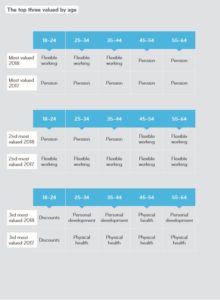
Flexible working and pensions highly valued across all age groups. Younger workers value flexible working over pensions, but those aged between 35 and 64 appreciate their pension more than any other benefit.

This is an interesting shift from 2017, where pensions were the most valuable benefit across all age groups. Could this mean that flexible working is becoming more widely available, or has auto-enrolment made pensions ‘business as usual’ for younger workers?

Neyber’s full report – the DNA of financial wellbeing – can be found here.

www.neyber.co.uk

Rebecca joined the HRreview editorial team in January 2016. After graduating from the University of Sheffield Hallam in 2013 with a BA in English Literature, Rebecca has spent five years working in print and online journalism in Manchester and London. In the past she has been part of the editorial teams at Sleeper and Dezeen and has founded her own arts collective.

Latest news

Personalising the Benefits Experience: Why Employees Need More Than Just Information

This article explores how organisations can move beyond passive, one-size-fits-all communication to deliver relevant, timely, and simplified benefits experiences that reflect employee needs and life stages.

Grant Wyatt: When the love dies – when staying is riskier than quitting

When people fall out of love with their employer, or feel their employer has fallen out of love with them, what follows is rarely a clean exit.

£30bn pension savings window opens for employers ahead of 2029 reforms

UK employers could unlock billions in National Insurance savings by expanding pension salary sacrifice schemes before new limits take effect in 2029.

Expat jobs ‘fail early as costs hit $79,000 per worker’

International assignments are ending early due to family strain, isolation and poor preparation, as rising costs increase pressure on employers.
- Advertisement -

The Great Employer Divide: What the evidence shows about employers that back parents and carers — and those that don’t

Understand the growing divide between organisations that effectively support working parents and carers — and those that don’t. This session shows how to turn employee experience data into a clear business case, linking care-related pressures to performance, retention and workforce stability.

Scott Mills exit puts spotlight on risk of ‘news vacuum’ in high-profile dismissals

Sudden departure of a long-serving BBC presenter raises questions about how employers manage high-profile dismissals and limit speculation.

Must read

Who needs a CV when you have so many biases?

Being a start-up is all about design-thinking and experimentation. You try various options, test hypotheses and develop contingencies to help solve customers solutions in a creative way.  Thus, when confronted with the question;  “Does the CV format works?”, we decided to conduct a simple experiment of our own.

Alan Erskine: Workforce planning – how hard can it be?

It seems that barely a week goes by without...
- Advertisement -

You might also likeRELATED
Recommended to you



