
<

!Google ads have two elements of code. This is the 'header' code. There will be another short tag of code that is placed whereever you want the ads to appear. These tags are generated in the Google DFP ad manager. Go to Ad Units = Tags. If you update the code, you need to replace both elements.> <! Prime Home Page Banner (usually shows to right of logo) It's managed in the Extra Theme Options section*> <! 728x90_1_home_hrreview - This can be turned off if needed - it shows at the top of the content, but under the header menu. It's managed in the Extra Theme Options section * > <! 728x90_2_home_hrreview - shows in the main homepage content section. Might be 1st or 2nd ad depending if the one above is turned off. Managed from the home page layout* > <! 728x90_3_home_hrreview - shows in the main homepage content section. Might be 2nd or 3rd ad depending if the one above is turned off. Managed from the home page layout* > <! Footer - 970x250_large_footerboard_hrreview. It's managed in the Extra Theme Options section* > <! MPU1 - It's managed in the Widgets-sidebar section* > <! MPU2 - It's managed in the Widgets-sidebar section* > <! MPU - It's managed in the Widgets-sidebar section3* > <! MPU4 - It's managed in the Widgets-sidebar section* > <! Sidebar_large_1 - It's managed in the Widgets-sidebar section* > <! Sidebar_large_2 - It's managed in the Widgets-sidebar section* > <! Sidebar_large_3 - It's managed in the Widgets-sidebar section* > <! Sidebar_large_4 - It's managed in the Widgets-sidebar section* > <! Sidebar_large_5 are not currently being used - It's managed in the Widgets-sidebar section* > <! Bombora simple version of script - not inlcuding Google Analytics code* >

Employee Resignations at Five Year High (and are 8.2% in HR)

-

Resignations Up in 2017
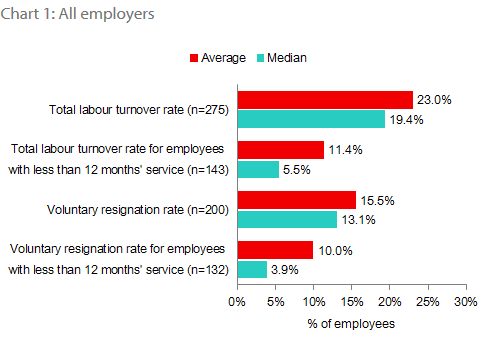
Chart 1: Resignations, All Employers 2017 (Click to enlarge).

One in seven (15.5%) employees resigned from the job in 2016, according to the latest data from XpertHR. Labour turnover statistics from 288 organisations show that the resignation rate has increased steadily since 2012, when it stood at 10.6%.

HR has the fourth highest voluntary resignation levels out of the groups measured, with rates up for the second consecutive year, standing at 8.2% – up from 7.4% in 2016 and 6.3% in 2015.

The other occupational groups with high resignation rates were distribution at 12.4%, publishing and events at 12.3% and the voluntary sector at 8.8%.

Using an alternative measure that tracks voluntary turnover at the midpoint or median, resignations have increased from 8.9% to 13.1% over the same period.

Total labour turnover (which covers all types of departures, including voluntary resignations, redundancies, dismissals and retirements) stands at an average 23% and a median of 19.4%, a modest increase from 2015 – when the average was 21.5% and the median 18.5%.

In HR the labour turnover is the third highest at 12%, with only publishing and events at 17% and distribution at 13.5% having higher levels.

Staff turnover among employees with less than 12 months’ service

For the first time, XpertHR has also recorded turnover rates among employees with less than 12 months’ service. Monitoring resignation rates and total turnover among this group is important due to the high costs and implications of recruiting and onboarding.

The data shows that one in 10 (10%) new starters resigned before completing a year’s service – with total turnover for all reasons at 11.4%.

Companies in the services sector had the highest rate of attrition among new starters. On average, 11.6% new employees left voluntarily in their first year, with total labour turnover at 13.1%.

XpertHR senior HR practice editor Noelle Murphy, said:

“Monitoring staff turnover is important for all organisations so that they can respond quickly when levels reach a point that is damaging to the business. Our data on turnover rates among those with less than 12 months’ service shows just how important it is for HR to look carefully at its recruitment and selection strategy – and its onboarding process. Ensuring new starters receive ongoing support and attention, and have the opportunity to raise any concerns as soon as possible, can help to avoid staff churn among this group. Losing an average of one in 10 employees before completing one year of service is not only costly in terms of resources, but also for employee engagement among those already in post.”

Latest news

Turning Workforce Data into Real Insight: A practical session for HR leaders

HR teams are being asked to deliver greater impact with fewer resources. This practical session is designed to help you move beyond instinct and start using workforce data to make faster, smarter decisions that drive real business results.

Bethany Cann of Specsavers

A working day balancing early talent strategy, university partnerships and family life at the international opticians retailer.

Workplace silence leaving staff afraid to raise mistakes

Almost half of UK workers feel unable to raise concerns or mistakes at work, with new research warning that workplace silence is damaging productivity.

Managers’ biggest fears? ‘Confrontation and redundancies’

Survey of UK managers reveals fear of confrontation and redundancies, with many lacking training to handle difficult workplace situations.
- Advertisement -

Mike Bond: Redefining talent – and prioritising the creative mindset

Not too long ago, the most prized CVs boasted MBAs, consulting pedigrees and an impressive record of traditional experience. Now, things are different.

UK loses ground in global remote work rankings

Connectivity gaps across the UK risk weakening the country’s appeal to remote workers and internationally mobile talent.

Must read

The rise and rise of global mobility – NO REGISTRATION REQUIRED

Global Mobility or Expatriate Management is as old as humankind itself. The ancient migration routes of our earliest ancestors are well documented and the distances travelled by primitive man still continue to amaze. Brian Friedman explains more..

Alex Voakes: Why the right to requesting a four-day working week should have been included in the Employment Rights Bill

While the Employment Rights Bill its emphasis on flexibility is a step in the right direction, there is a key measure missing...
- Advertisement -

You might also likeRELATED
Recommended to you

Exit mobile version




