
Pay increases have edged up at the start of 2026, offering a modest lift for workers after a year of largely flat settlements and signalling a cautious return to slightly stronger wage growth.
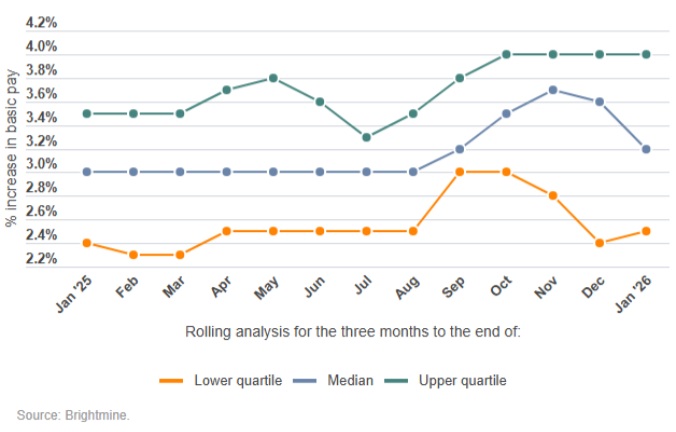
Median basic pay awards reached 3.2% in the three months to the end of January, up from the 3% level that persisted through most of 2025. While the increase is small, it marks one of the first signs that employers are beginning to move away from last year’s holding pattern on pay.
There are also indications that more organisations are improving their offers, with a growing share of settlements exceeding those awarded to the same employee groups a year earlier.
Employers weigh affordability against talent pressures
An analysis by Brightmine, a provider of HR data and labour market insights, shows that around 41.7% of pay deals were higher than the previous year, compared with 37.5% that were lower and 20.8% that remained unchanged. This points to a gradual increase in upward movement on pay, though not a uniform one.
 |
Get our essential weekday HR news and updates.
|

Sheila Attwood, a senior content manager for data and HR insights at Brightmine, said employers were beginning the year with slightly more flexibility after a prolonged period of stability. “January’s awards point to a shift towards slightly higher settlements after a prolonged period of stability.”
She said the economic backdrop continued to shape decision-making, with employers balancing competing priorities.
“However, downgraded growth forecasts and rising unemployment projections underline wider economic challenges. Therefore, employers are likely to maintain a cautious approach, carefully weighing affordability against the need to attract and retain talent.”

That tension between cost control and talent retention remains central to pay decisions. Many employers are still facing recruitment challenges in key roles, even as broader hiring confidence has weakened.
Pay settlements widen as pressures build
The spread of pay awards has widened in early 2026, with increases ranging from 0% to 5%. Pay freezes accounted for 6.8% of settlements, while the most common award remained 3%.
Most deals, around 64.4%, fell within a relatively narrow band of between 3% and 4%, suggesting that employers are clustering around a cautious midpoint rather than making large adjustments.
Where organisations did increase awards compared with last year, the median rise reached 3.5%. By contrast, awards that stayed the same or declined remained at a median of 3%, reinforcing the picture of selective rather than widespread pay growth.
This more varied pattern reflects a labour market that is no longer moving in one direction. Some employers are responding to ongoing skills shortages and retention risks with higher awards, while others are holding back in response to economic uncertainty.
Economic outlook tempers pay growth
The broader economic environment continues to weigh on employer confidence. Output growth remained weak at 0.1% in the final quarter of 2025, while unemployment has risen more than expected in recent data releases.
These conditions are likely to limit how far pay awards can increase over the course of 2026, particularly if businesses face continued pressure on margins.
Attwood said upcoming policy changes would add further constraints to pay decisions.
“Affordability is front of mind with the upcoming increases to the National Living Wage in April, which will require higher rises for the lowest-paid workers. These will absorb a larger share of pay budgets and leave less headroom for pay progression elsewhere.”
The increase in the statutory wage floor is expected to push up costs for employers with large lower-paid workforces, potentially narrowing the scope for broader pay progression across organisations.
At the same time, expectations among employees remain shaped by recent years of high inflation, even as price pressures begin to ease. This creates a challenge for employers attempting to balance workforce expectations with financial realities.
The data reflects 59 pay settlements covering more than 238,000 UK employees, with awards taking effect between November 2025 and January 2026. The outlook remains finely balanced, observers say, as employers navigate a complex mix of economic pressures and workforce demands.


William Furney is a Managing Editor at Black and White Trading Ltd based in Kingston upon Hull, UK. He is a prolific author and contributor at Workplace Wellbeing Professional, with over 127 published posts covering HR, employee engagement, and workplace wellbeing topics. His writing focuses on contemporary employment issues including pension schemes, employee health, financial struggles affecting workers, and broader workplace trends.
- William Furney

- William Furney

- William Furney

- William Furney