

Hiring confidence is rising among UK employers, but the Autumn Budget could either reinforce or derail recovery, according to the Recruitment and Employment Confederation (REC).
The organisation, which represents the UK’s recruitment sector, said firms were showing growing optimism about hiring and investment, especially in the private sector. But it warned that last year’s Budget dampened employer confidence and urged the government not to repeat the same approach.
The call comes as new findings from the REC’s JobsOutlook report show short- and medium-term hiring expectations both increased during the summer, despite continued concern about the wider economy.
Hiring intentions rise but concerns remain
Based on a survey of 704 UK employers carried out between June and August 2025, the data showed that short-term permanent hiring expectations rose by six percentage points to a net +18 percent. Medium-term hiring intent also improved to +20 percent, up from +14 percent in the previous quarter.
 |
Get our essential weekday HR news and updates.
|

Temporary hiring is also gaining momentum, with short-term demand rising to +14 percent, and medium-term demand climbing from +13 percent in June to +21 percent in August.

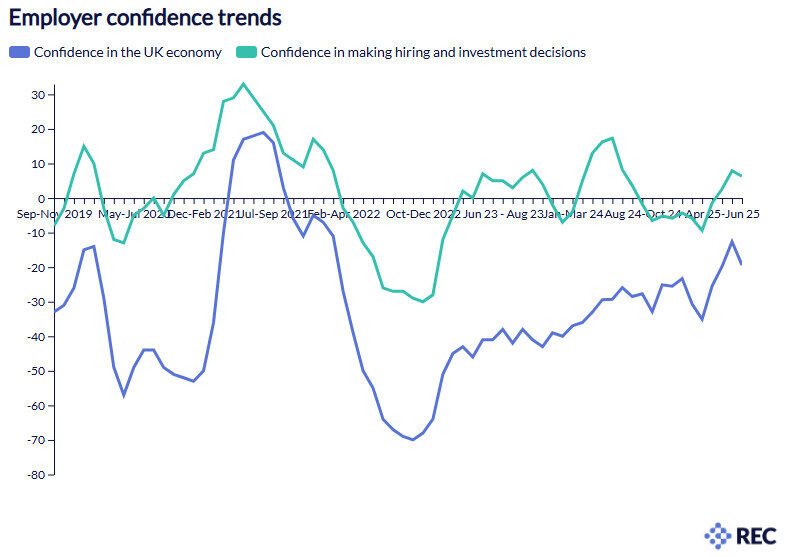
Confidence in firms’ own ability to invest and hire rose four points to a net +7 percent. But confidence in the wider UK economy remained firmly negative at -19, pointing to ongoing caution.
The REC said that employers were becoming more confident in their own outlook but remained wary of policy changes and operating costs. Last year’s Budget, it said, contributed to a hiring slowdown and should serve as a warning.
2024 Budget ‘dented business confidence’
In 2024, the Autumn Budget increased National Insurance rates and followed through on a 25 percent rise in the minimum wage over three years. Employers also raised concerns about new legal risks under the Employment Rights Bill, including concerns over protracted tribunal cases even during probation periods.
The REC’s chief executive, Neil Carberry said, said the combination of tax rises and regulatory uncertainty had unsettled businesses and weakened their appetite to hire. “The story of the last year has been businesses getting more confident in themselves, but holding off on investment and hiring because of wider economic, policy and technology concerns,” he said.
“That may be starting to change as last year’s Budget fades from view; some sectors like construction bounce back and interest rates are stable. But it just serves to triple-underline that the impact on businesses of this autumn’s Budget decisions needs to be the opposite of last year: only business confidence can drive growth, so the Budget must underpin it.”
Regional and private sector demand leads the way
The JobsOutlook data found that employers in London were leading both permanent and temporary hiring demand, followed by regions such as the North West and the Midlands. Private sector hiring intentions were stronger than those in the public sector.
The REC said this pointed to where Budget support should be focused, backing the parts of the economy with the strongest growth potential and removing barriers to job creation.
It also noted that recovery was uneven, and many businesses were still navigating economic pressures, including high input costs and a slowdown in consumer spending.
Policy choices could tip the balance
With Chancellor Rachel Reeves expected to deliver the Autumn Budget in November, employer groups are urging the Treasury to avoid repeating the perceived missteps of 2024.
The REC said that while tax cuts were unlikely, the government could boost confidence by pausing further tax rises on employment, offering clarity on employment law changes and investing in training to address sectoral skills shortages.
The REC said this year’s Budget must send a clear signal to businesses that the government is on their side. That means avoiding last-minute regulatory changes, resisting the temptation to raise employment-related taxes and focusing on long-term conditions for growth.
While fiscal pressures remain, employer groups say growth is the only viable route to boosting tax revenues and funding public services. But that growth, they argue, depends on firms being able to hire, train and retain staff with confidence.
The final quarter of 2025 may prove pivotal. The REC said that if confidence-building measures are included in the Budget, the recent uptick in employer sentiment could translate into real job creation. If not, fragile gains could be lost before they have a chance to take hold.


William Furney is a Managing Editor at Black and White Trading Ltd based in Kingston upon Hull, UK. He is a prolific author and contributor at Workplace Wellbeing Professional, with over 127 published posts covering HR, employee engagement, and workplace wellbeing topics. His writing focuses on contemporary employment issues including pension schemes, employee health, financial struggles affecting workers, and broader workplace trends.
- William Furney

- William Furney

- William Furney

- William Furney