<

!Google ads have two elements of code. This is the 'header' code. There will be another short tag of code that is placed whereever you want the ads to appear. These tags are generated in the Google DFP ad manager. Go to Ad Units = Tags. If you update the code, you need to replace both elements.> <! Prime Home Page Banner (usually shows to right of logo) It's managed in the Extra Theme Options section*> <! 728x90_1_home_hrreview - This can be turned off if needed - it shows at the top of the content, but under the header menu. It's managed in the Extra Theme Options section * > <! 728x90_2_home_hrreview - shows in the main homepage content section. Might be 1st or 2nd ad depending if the one above is turned off. Managed from the home page layout* > <! 728x90_3_home_hrreview - shows in the main homepage content section. Might be 2nd or 3rd ad depending if the one above is turned off. Managed from the home page layout* > <! Footer - 970x250_large_footerboard_hrreview. It's managed in the Extra Theme Options section* > <! MPU1 - It's managed in the Widgets-sidebar section* > <! MPU2 - It's managed in the Widgets-sidebar section* > <! MPU - It's managed in the Widgets-sidebar section3* > <! MPU4 - It's managed in the Widgets-sidebar section* > <! Sidebar_large_1 - It's managed in the Widgets-sidebar section* > <! Sidebar_large_2 - It's managed in the Widgets-sidebar section* > <! Sidebar_large_3 - It's managed in the Widgets-sidebar section* > <! Sidebar_large_4 - It's managed in the Widgets-sidebar section* > <! Sidebar_large_5 are not currently being used - It's managed in the Widgets-sidebar section* > <! Bombora simple version of script - not inlcuding Google Analytics code* >

Where do all the jobs come from?

-

The UK is currently enjoying its highest level of employment, with 32 million people in work across the country.  Not only this but rates of unemployment are at their lowest levels since 1975.  But where are all the jobs coming from?  Is your industry responsible?

RS Components have analysed 40 years of ONS data to show which industries are creating the most jobs in today’s vibrant market, and there are clear winners and losers.

Real Estate takes the crown for the industry that has grown the most since 1987.  Despite being a relatively small sector overall, it has achieved a whopping 142% increase!  So when you’re thinking about the soaring prices of property and the constant demand for homes, it is hardly surprising that jobs in Real Estate are growing so rapidly.

Science and Technology takes second place in the highest job growth rankings, adding just over 1.6 million jobs to the UK market since 1987, a percentage increase of 130%. With the tech boom of the 90s and 00’s, this is an industry that is only going to get bigger, especially as the UK cements itself as a global leader in the sector.  In addition, administrative roles and positions in Information & Communication have seen very healthy increases, with 2.3 million jobs added to the UK economy over the last 40 years.

Sitting at the bottom of the infographic are the industries where job vacancies have shrunk. Unsurprisingly Mining & Quarrying has seen the biggest percentage decrease in vacancies, with jobs falling 69% since 1987. Although still a major industry in the UK job market, Manufacturing is seconded biggest jobs loser, shedding almost 2.3 million positions over the last four decades, no doubt partly due to huge developments in automation.

It’s clear from the last four decades of job data that the UK is changing focus, slowly shifting from the industrial Britain of old to the services and tech Britain of the future. But which industries will survive the next forty years?
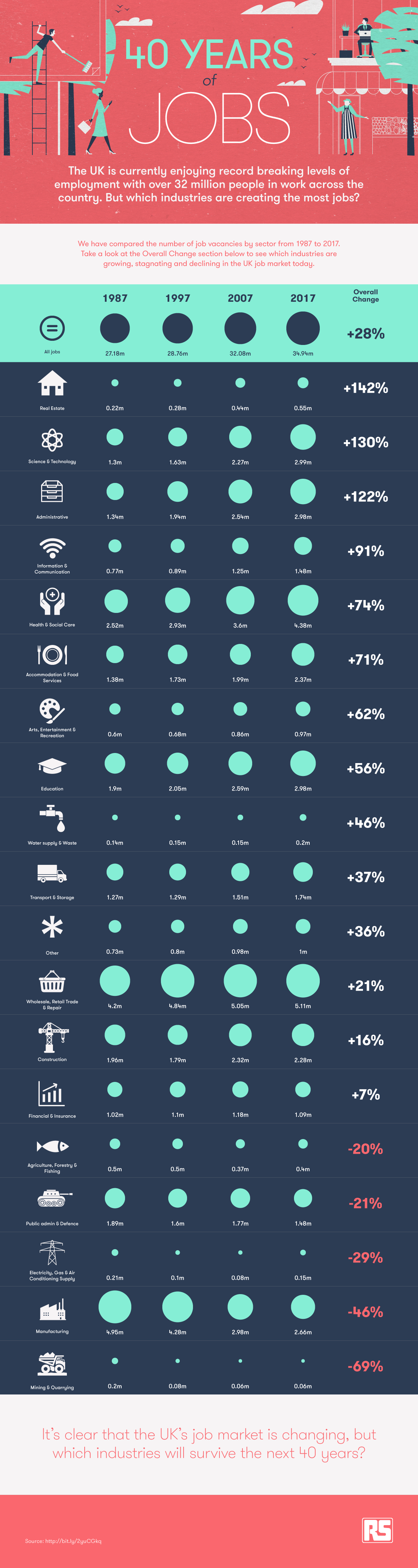
Click the infograpic below to enlarge:
40 Years of Jobs Infographic


Latest news

Turning Workforce Data into Real Insight: A practical session for HR leaders

HR teams are being asked to deliver greater impact with fewer resources. This practical session is designed to help you move beyond instinct and start using workforce data to make faster, smarter decisions that drive real business results.

Bethany Cann of Specsavers

A working day balancing early talent strategy, university partnerships and family life at the international opticians retailer.

Workplace silence leaving staff afraid to raise mistakes

Almost half of UK workers feel unable to raise concerns or mistakes at work, with new research warning that workplace silence is damaging productivity.

Managers’ biggest fears? ‘Confrontation and redundancies’

Survey of UK managers reveals fear of confrontation and redundancies, with many lacking training to handle difficult workplace situations.
- Advertisement -

Mike Bond: Redefining talent – and prioritising the creative mindset

Not too long ago, the most prized CVs boasted MBAs, consulting pedigrees and an impressive record of traditional experience. Now, things are different.

UK loses ground in global remote work rankings

Connectivity gaps across the UK risk weakening the country’s appeal to remote workers and internationally mobile talent.

Must read

Anton Roe: Youth unemployment, what a nightmare

Youth unemployment; we’ve actually reached 2.5 million. I never...

Jeff Lovejoy: Diversity as a part of our DNA

Jeff Lovejoy, UK and Ireland Recruitment Manager at FDM Group, who is speaking at the forthcomingEarly Career and Development Summit 2017, discusses how FDM embeds diversity and inclusion in its career programmes and organisation.
- Advertisement -

You might also likeRELATED
Recommended to you

Exit mobile version



