


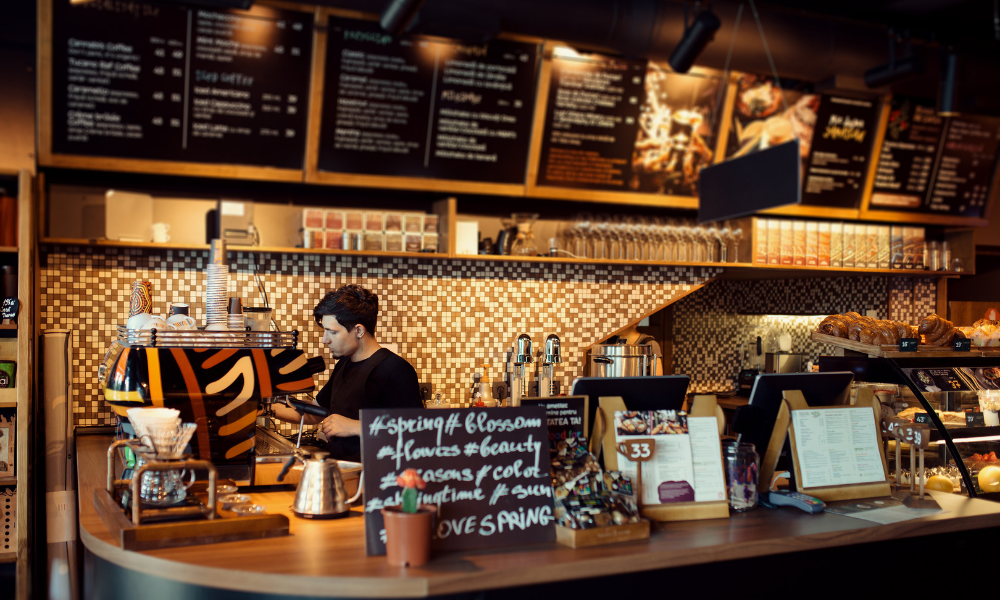

Working latte again? Brits are treating coffee shops as their second office, with one in four (23%) working from them at least once a week, research by comparison site Broadband Genie reveals.
With 33 million people employed in the UK, that means over seven million workers are regularly choosing a café over their home or office to get the job done.
When it comes to mixing the daily grind with their daily brew, three in five (60%) coffee shop-loving remote workers named Costa Coffee as a favourite place to work, ahead of Starbucks (38%) and Caffè Nero (26%).
The UK is Europe’s largest market for coffee shop outlets, and the average Brit spends over £700 a year in them – double the typical annual broadband bill.
 |
Get our essential weekday HR news and updates.
|

The most common reason given for working in a coffee shop is to be around other people (34%), while a quarter claim it improves their productivity (27%).
A more flexible attitude
With more flexible attitudes to employment, 44 percent of UK workers now do their jobs fully or partly from home, and Britain was recently found to be the working-from-home capital of Europe.
One in seven workers (16%) say they pick a coffee shop to work from as they prefer its atmosphere to their office. Meanwhile, 15 percent say that they work in a café to try and save money on their energy bill.
While a few hours working from a café is a preference for some workers, for others, it can be a necessity due to issues with their broadband.
Three in five consumers (60%) have suffered a broadband outage at home in the last year, and a quarter (25%) say disruptions to their internet service have prevented them from being able to do their job.
In the wake of recent high-profile outages for Virgin Media and Sky, broadband provider problems were reported as the biggest cause of lost connections, affecting one in four (25%) households.
Alex Tofts, broadband expert at Broadband Genie, comments:
“The last few years have seen a huge shake-up in the ways we work. Remote roles, initially forced by the pandemic, have now evolved to become flexible jobs where people divide their working week between the office and their home.
“Our research shows that many hybrid workers are also now adding their favourite coffee shop into the mix. The change of scenery can be particularly tempting if you are not a fan of your home set-up, or frustrated by misfiring Wi-Fi.
“Yet, with the average latte setting you back £3.25, the cost of days in a coffee shop can quickly add up. For those looking to save money, there are many ways to improve your broadband connection that are far cheaper than buying a brew.”
Here are some tips from Broadband Genie on how to improve your Wi-Fi and home working set-up:
- Right your router – Make sure your router is in the centre of your home and not behind furniture to avoid obstructing your Wi-Fi signal.
- Boost it up – If working on a different floor from your router, consider getting a broadband booster. Last month, Sky introduced Wi-Fi Max, which includes a minimum speed guarantee for every room of the house.
- Off the pace – If your broadband seems sluggish, check the minimum speeds your provider guarantees for your package and compare them with a speed test.
- Speak up – Whether it’s an outage or underperformance, make sure you report any issues to your provider. If you have a mobile contract with a generous data allowance, tether your computer to your smartphone if you get disconnected. For outages over 48 hours, you should receive automatic compensation of £9.33 per day.
- Prepare to switch – Near the end of your deal, or out of contract? Look to see what other packages are on offer. The chances are you will be able to save by switching to a similar deal, or even upgrade your speed without paying more.


Amelia Brand is the Editor for HRreview, and host of the HR in Review podcast series. With a Master’s degree in Legal and Political Theory, her particular interests within HR include employment law, DE&I, and wellbeing within the workplace. Prior to working with HRreview, Amelia was Sub-Editor of a magazine, and Editor of the Environmental Justice Project at University College London, writing and overseeing articles into UCL’s weekly newsletter. Her previous academic work has focused on philosophy, politics and law, with a special focus on how artificial intelligence will feature in the future.
- Amelia Brand

- Amelia Brand

- Amelia Brand

- Amelia Brand





