


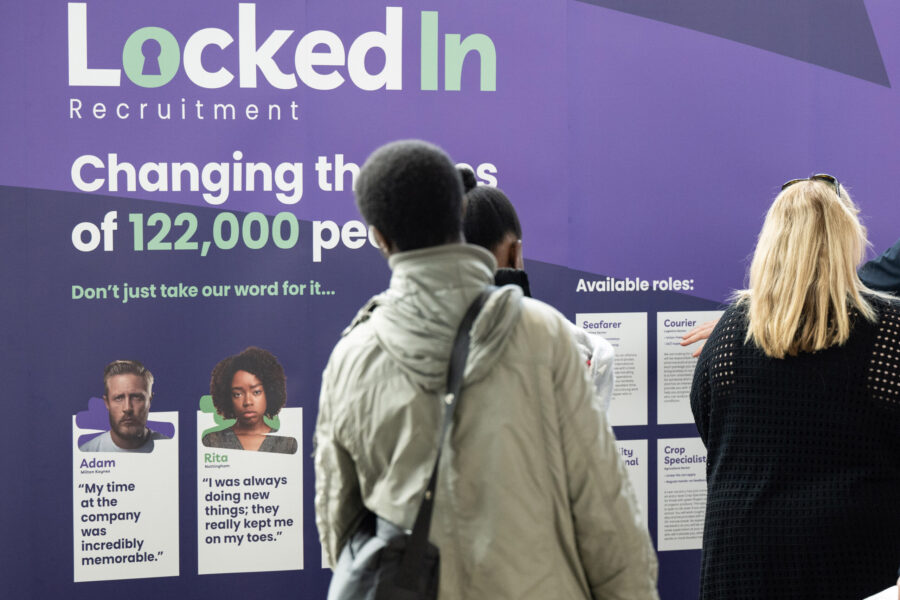

On the International Day for the Abolition of Slavery (2 December), the charity Migrant Help unveils a provocative campaign at the UK Careers Fair to raise awareness about modern slavery.
Disguised as a fake recruitment agency named ‘LockedIn Recruitment’, the organisation showcased job opportunities that mimic the real-life experiences of modern slavery survivors.
The campaign’s goal was to expose the tactics traffickers use to exploit vulnerable individuals and highlight the alarming prevalence of modern slavery in the UK. Recent figures show a 33 percent annual increase in reported cases, with an estimated 122,000 people currently trapped in exploitative conditions across the country.
LockedIn Recruitment: A Dark Satire on Exploitation
LockedIn Recruitment’s roles were designed to mirror the harsh realities faced by survivors of modern slavery. The positions included a live-in nanny denied breaks, a seafarer forced to work 21-hour days, and a waiter subjected to physical punishment. These were no tales of fiction: each role was inspired by survivor stories collected by Migrant Help, demonstrating how modern slavery spans multiple industries.
 |
Get our essential weekday HR news and updates.
|

Modern slavery occurs when individuals lose their freedom and are exploited for profit. This exploitation can take many forms – including forced labour, criminal exploitation, sexual exploitation, and domestic servitude. For every person rescued, statistics suggest that seven more remain trapped in captivity.
Loretta, whose own experience of modern slavery inspired the live-in nanny job role, said, “After graduating from nursing school and working in a hospital in Nigeria, I was offered a job by a family to look after their children at home. When they relocated to the UK, I went with them. It was then that my situation rapidly deteriorated. The family took my passport away, would not let me to go outside, and refused to pay me for my work.
“Thankfully I got out, and I now work as a nurse for the NHS, as well as acting as a Migrant Help trustee in the hope I can help people going through similar situations to mine. But not everyone is so lucky. The Unfair Jobs Fair is so important because it brings to light what so many people don’t realise – that modern slavery is happening all around us, often in plain sight.”
Modern Slavery’s Reach in the Workplace
Industries including hospitality, agriculture, and construction are at higher risk of harbouring exploitative practices, either directly or through subcontracted labour. Common signs that someone may be a victim of modern slavery include restricted freedom of movement, excessive working hours with no breaks, poor living conditions. They may also be in too much fear to seek help, and show signs of physical or psychological abuse.
Rabiya Ravat, Director of Modern Slavery Services at Migrant Help, commented, “Modern slavery is not just a problem overseas – it’s happening here, in the UK, in our towns and cities, and often to British citizens, too.
“Through the Unfair Jobs Fair, we want to confront people with the reality that modern slavery can be hidden in ordinary places, often masquerading as legitimate work opportunities. The shock and emotional reactions we captured are a testament to how deeply this issue impacts people when they come face to face with it.
“We need people to recognise the signs of modern slavery and understand that help is available. Victims are often isolated, frightened, and unaware of their rights. At Migrant Help, we work to provide support, guidance, and a safe space for survivors to rebuild their lives. The Unfair Jobs Fair is part of our ongoing mission to raise awareness, engage the public, and ultimately end modern slavery.”
Those who suspect someone may be trapped in modern slavery are urged to contact the 24/7 confidential Modern Slavery & Exploitation Helpline at 08000 121 700.
Image by Jeff Spicer/PA Media Assignments.


Alessandra Pacelli is a journalist and author contributing to HRreview, where she covers topics including labour market trends, employment costs, and workplace issues.
- Alessandra Pacelli

- Alessandra Pacelli

- Alessandra Pacelli

- Alessandra Pacelli




